
What Are We Really Opposing When We Fight Monopoly?

The market is by no means a simple concept, and its definition should not be too broad. Equally important is recognizing that the “correct” definition of the market depends on how the concept is used.
——Jean Marcel Tirole, The Theory of Industrial Organization
Antitrust is widely regarded as a matter of justice. Yet once we enter the actual sea of markets, where countless firms compete, merge, maneuver, and collide, the very meaning of monopoly becomes far more complicated than it first appears. How should monopoly be defined? What kinds of monopoly ought to be restrained? This essay records a set of reflections drawn from coursework in industrial economics. The first half briefly reviews the economic foundations of monopoly; the second half turns to reforms in China’s antitrust law.
Review of Basic Economic Knowledge
What is Monopoly?
In practice, monopoly usually appears in several broad forms:
Natural Monopoly: Monopoly generated by cost subadditivity, meaning that a single large-scale producer can operate more efficiently, with lower average costs, than several firms producing simultaneously. In practice, this often appears where resources are scarce or economies of scale are strong. A firm may lower costs by integrating upstream and downstream businesses or by acquiring strategically scarce resources.
A contemporary example is the platform economy. Platform industries often have high fixed costs in infrastructure and very low marginal costs for serving additional users. Once a platform has invested heavily in infrastructure, it has every incentive to keep expanding, because doing so reduces average cost. This is why industries with natural-monopoly characteristics, such as electricity, gas, telecommunications, and long-distance transportation, are often directly controlled by the state or subject to price regulation.
This is why Coase contemplated that the origin of firms might stem from
transaction costs—achieving transactions requires additional costs, and corporate entities help reduce transaction costs. Natural monopoly reduces average costs through corporate expansion.
Administrative Monopoly: The state grants a firm exclusive rights to produce a particular good or provide a particular service.
Resource Monopoly: Key resources are owned by a single enterprise.
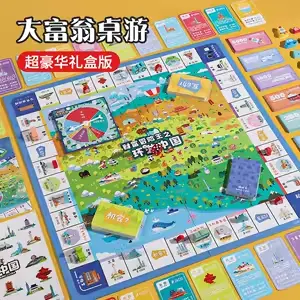
There was once a very popular childhood board game, Monopoly. Players roll dice, buy and sell property, and try to accumulate wealth. The original purpose of the game, however, was not to glorify monopoly but to illustrate its harms.
Causes of Monopoly
To understand monopoly is also to understand firms. Because firms pursue profit maximization, they are naturally drawn toward market power, collusion, and strategic exclusion. Monopoly therefore offers one important lens through which to study how markets actually operate. It is also a topic with no single definitive framework; even today there remains room for new models, new explanations, and more unified ways of thinking about how monopoly arises.
- Cost Subadditivity: This may arise from technological conditions or from economies of scale.
- Resource Control: The crucial resource need not be natural. In today’s economy, for example, Tencent’s social platforms command enormous user resources. The social dimension of Honor of Kings depends heavily on those network resources, and premium liquor brands such as Moutai enjoy strong bargaining power over downstream markets.
- Administrative Causes: Government policy can create or reinforce monopoly, whether through licensing systems, price controls, or other forms of regulatory privilege.
- Corporate Collusion: In empirical research, it is often important to consider the interaction among several causes at once. Government policy, for example, may induce or stabilize collusion. One of Tirole’s major contributions was to bring game theory deeply into the analysis of market competition, thereby advancing industrial organization as a field.
- Historical Causes: Sometimes a firm gains advantage simply because it was first to establish a favorable industry standard. What is now called the
first-mover economycan also be understood as historical contingency or an extension of first-mover advantage. The diamond industry is a classic case: not merely a story of marketing, but of an early dominant firm shaping the very way the market came to function.
The Good and Bad of Monopoly
Why break monopolies? Do all monopolies need to be broken?
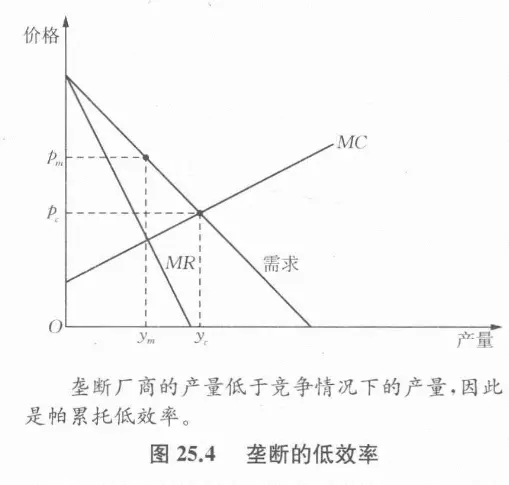
The central normative goal of antitrust is the maximization of social welfare, or more broadly, the maximization of efficiency.
In perfectly competitive markets, equilibrium corresponds to $MC=P$. In monopoly markets, the profit maximization condition for firms is: $MC=MR$. Pricing above marginal cost and output below the level corresponding to social welfare maximization are considered inefficient.
But does monopoly have no positive side at all? Not necessarily. The patent system, for example, is a form of limited monopoly, and under some conditions such monopoly can stimulate innovation.
This gives rise to a familiar inverted-U style debate: how much monopoly power promotes innovation, and at what point does it begin to suppress it? At the level of patent design, questions such as the length of protection, filing costs, and the scope of protection all remain open and important.
In perfectly competitive markets, firms have no pricing power; price is exogenous to the firm. Under monopoly or market power, however, firms acquire some control over pricing, which naturally raises the issue of price discrimination. Although the term often carries a negative connotation in ordinary language, in economics it refers to a pricing strategy. In some settings, if price discrimination expands the volume of trade, it may even raise social welfare.
Monopoly Behavior
- Price: Includes price discrimination (first-degree price, second-degree quantity, third-degree object preference).
- Market Power: Can be subdivided with many hypotheses: consumer market or producer market? Products or factors? Homogeneous or heterogeneous products? Upstream or downstream? Domestic or international market? Price leadership or quantity leadership? What is the sequence of the game? Is the game static or dynamic? Does it involve information asymmetry?
In periods of economic slowdown, the transmission of market power and cost pressures has increasingly become a major research topic.
How Governments Combat Monopoly: A Brief Discussion of Antitrust Law
Governments typically respond to monopoly through a mix of price controls, merger review, taxation, fines, administrative sanctions, and antitrust law.
The earliest antitrust law in the United States was the Sherman Antitrust Act.
China’s first antitrust case was the 2008 Coca-Cola Acquisition of Huiyuan Incident.
Huiyuan, a major domestic private firm, wanted to sell itself to Coca-Cola. Chinese public opinion was broadly reluctant to see a well-known domestic brand sold abroad, while much of the international commentary argued that blocking the deal showed China to be excessively strict in regulating market conduct.
In the end, Chinese regulators judged the transaction to involve monopoly concerns. After the deal collapsed, Huiyuan’s stock price fell sharply and the firm’s operating condition continued to deteriorate. Chinese economist Lang Xianping memorably argued that Coca-Cola lost because it was too arrogant.
What Are We Opposing in Antitrust?
In 2009, the Ministry of Commerce of the People’s Republic of China issued Announcement No. 22 of 2019 regarding the Coca-Cola acquisition of Huiyuan case:
- After the concentration, Coca-Cola Company would have the ability to extend its dominant position in the carbonated soft drink market to the juice beverage market, producing exclusionary and restrictive competitive effects on existing juice beverage enterprises, thereby harming the legitimate rights and interests of beverage consumers.
- Brand is a key factor affecting effective competition in the beverage market. After the concentration, Coca-Cola Company, by controlling the two well-known juice brands “Minute Maid” and “Huiyuan,” would significantly enhance its control over the juice market. Combined with its existing dominant position in the carbonated beverage market and corresponding transmission effects, the concentration would significantly raise barriers for potential competitors to enter the juice beverage market.
- The concentration squeezes the survival space of domestic small and medium-sized juice enterprises, inhibits domestic enterprises’ ability to participate in competition and engage in independent innovation in the juice beverage market, adversely affects the effective competitive landscape of China’s juice beverage market, and is detrimental to the sustainable and healthy development of China’s juice industry.
The core principle reflected here is simple: antitrust targets monopoly behavior, not monopoly position as such.
From the standpoint of basic economics, there are two broad ways to judge whether a firm is monopolistic.
- Market Share. If a company becomes a behemoth in the market, we can consider it a monopoly.
- Monopoly Behavior. Our concern is that when a company’s share is sufficiently large, it may cause harm to other enterprises or consumers. The worry is not the monopoly position itself, but the monopoly behavior that may arise in the future.
But how large must market share be before we are willing to call it monopoly? The 2001 U.S. case United States v. Microsoft Corp., for example, treated Microsoft’s bundling of Internet Explorer with Windows as monopolistic conduct in the browser wars.
Microsoft’s defense was that Internet Explorer was a feature of the operating system, not a separate product. Ultimately, Microsoft was still found guilty of monopoly, though the federal government and Microsoft reached some compromises.
If Internet Explorer were treated merely as one more feature of the operating system, then Microsoft’s operating-system share alone would not settle the monopoly question. This illustrates why market share by itself is often too crude a standard.
Market share is itself hard to calculate, because it depends on how one defines the relevant market. In the Coca-Cola/Huiyuan case, China effectively relied on a market definition centered on “carbonated soft drinks.”
There are other examples in China, such as Moutai and Wuliangye.
Article 14 of the Antimonopoly Law explicitly prohibits business operators and trading counterparts from “reaching agreements that restrict the minimum price for resale to third parties.”
The evidence that Wuliangye and Moutai constituted monopoly was:
Wuliangye and Moutai issued marketing supervision and handling notices stating: A very small number of Wuliangye brand operators and Wuliangye specialty stores acted willfully, disregarding rules, ignoring the overall situation, and lacking broad perspective, engaging in low-price, cross-regional, cross-channel improper sales of Wuliangye.
From the perspective of Moutai and Wuliangye, they were engaged in normal price negotiations as manufacturers with downstream distributors, combining their production costs for pricing. Other distilleries also had their own stipulated prices, representing normal market competition behavior.
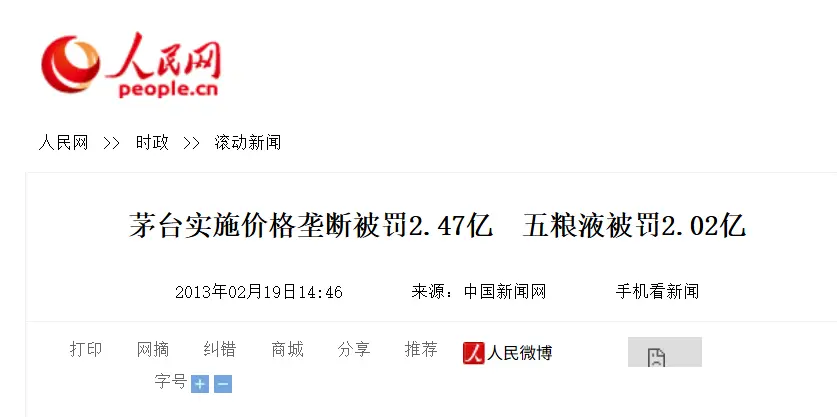
In this case, China defined Moutai and Wuliangye as “premium liquor brands” to calculate market share and subsequently determined monopoly.
Defects of Market Share as a Monopoly Standard
As these cases show, once market share is used as the central standard, everything turns on market definition. Different concepts yield different shares, which makes a unified standard difficult to sustain.
Two Nobel laureates, Friedman and Krugman, explicitly opposed the Microsoft monopoly case, viewing it as government interference harming market freedom.
The corresponding theoretical basis is a Chicago School concept—"Contestable Market."
Suppose there is a market with a single firm holding 100 percent of market share, but barriers to entry are low and rival firms can enter and exit at little cost. In that case, antitrust intervention may be unnecessary. Likewise, if a firm arrived at its position through ordinary technological progress and does not use that position to block the technological progress of others, then its monopoly position alone need not be condemned.
Historically, such cases may have been rare, but in the digital economy they are no longer hard to imagine. Tencent, for example, occupies an overwhelming share of China’s social-software market, yet because barriers to entry in internet-based social products are relatively low, monopoly in the strict antitrust sense is not automatic. The same logic helps explain why JD.com has recently challenged Meituan: for JD.com, its logistics infrastructure and platform-based model mean that entry barriers are significant but not insurmountable.
However, the contestable market theory also has drawbacks. For instance, firms might first use below-cost pricing to capture market share, then raise prices. Lei Jun once criticized his subordinates, saying what he wanted was not profit but market share. This strategy involves using low prices to capture the market first, then gaining dominance, which is why international trade opposes dumping.
Another example: Due to geographical factors, Shanxi people favor Fenjiu liquor. Should such substantial market share be subject to antitrust action?
Antitrust Law
Finally, consider the broader reform of China’s antitrust framework. Before 2008, China had no dedicated antitrust law and relied mainly on anti-unfair-competition rules and consumer-protection law for related enforcement.
Anti-Monopoly Law of the People’s Republic of China (2022 Amendment)
- Article 1: This Law is enacted to prevent and restrain monopoly conduct, protect fair market competition, encourage innovation, improve economic operational efficiency, safeguard consumer interests and social public interests, and promote the healthy development of the socialist market economy.
The relationship between monopoly and innovation follows an inverted U-shape. The 2022 amendment added “encourage innovation” as an objective in the general provisions. Article 1 also clearly states that antitrust opposes monopoly behavior, not position.
- Article 3: Monopoly conduct as referred to in this Law includes:
- (1) Monopoly agreements reached between business operators;
- (2) Abuse of dominant market position by business operators;
- (3) Concentrations of business operators that have or may have effect of eliminating or restricting competition.
The concept of concentration of business operators is thought-provoking, also involving the qualitative direction of industrial chains.
- Article 6: Business operators may, through fair competition and voluntary association, implement concentration according to law, expand business scale, and enhance market competitiveness.
- Article 7: Business operators with dominant market positions shall not abuse such positions to eliminate or restrict competition.
Clarifies that antitrust opposes monopoly behavior, not position. At least monopoly positions driven by innovative technology are not problematic. Subsequent provisions also allow exemptions for reasons involving foreign trade, crisis rescue, and social responsibility.
- Article 8: For industries where the state-owned economy holds a controlling position and are related to national economic lifelines and national security, as well as industries legally subject to exclusive operation and monopoly sales, the state protects the lawful business activities of their operators, and exercises supervision and regulation over their business conduct and the prices of their commodities and services according to law, safeguarding consumer interests and promoting technological progress.
State-monopolized industries possess special characteristics.
- Article 9: Business operators shall not use data and algorithms, technology, capital advantages, platform rules, etc., to engage in monopoly conduct prohibited by this Law.
Special background of the digital economy era.
- Article 24: Under any of the following circumstances, a business operator may be presumed to have a dominant market position:
- (1) The market share of one business operator in the relevant market reaches one-half;
- (2) The combined market share of two business operators in the relevant market reaches two-thirds;
- (3) The combined market share of three business operators in the relevant market reaches three-fourths.
Quantitative standards for monopoly position. The Coca-Cola and Huiyuan acquisition case standards relate to this.
- Article 25: Concentration of business operators refers to the following circumstances:
- (1) Merger of business operators;
- (2) A business operator acquiring control over other business operators by obtaining equity or assets;
- (3) A business operator acquiring control over other business operators or being able to exert decisive influence on other business operators through contracts or other means.
Concentration of business operators. Subsequent provisions also exclude equity situations and subsidiary-related companies.
-
Article 27: Under any of the following circumstances, concentration of business operators need not be declared to the State Council’s anti-monopoly enforcement agency:
-
(1) One business operator participating in the concentration holds more than fifty percent of the voting shares or assets of every other business operator;
-
(2) More than fifty percent of the voting shares or assets of every business operator participating in the concentration are held by the same business operator not participating in the concentration.
-
Article 33: When reviewing concentration of business operators, the following factors shall be considered:
-
(1) The market share of the business operators participating in the concentration in the relevant market and their control over the market;
-
(2) The degree of market concentration in the relevant market;
-
(3) The impact of the concentration on market entry and technological progress;
-
(4) The impact of the concentration on consumers and other relevant business operators;
-
(5) The impact of the concentration on national economic development;
-
(6) Other factors affecting market competition that the State Council’s anti-monopoly enforcement agency deems should be considered.
Comprehensive examination of monopoly share and monopoly behavior.
- Article 57: Where a business operator violates this Law by abusing a dominant market position, the anti-monopoly enforcement agency shall order it to cease the illegal conduct, confiscate illegal gains, and impose a fine of not less than one percent but not more than ten percent of the sales revenue of the previous year.
The fine standard is 1%–10% of the previous year’s sales revenue. This shows the investigation team has substantial discretionary power, with even 1% typically involving hundreds of millions in funds.
Summary
Why is monopoly such a central topic in industrial organization? Because industrial economics begins from the logic of profit maximization. Firms’ objectives shape how they compete, cooperate, exclude, collude, and negotiate. Once government and social welfare enter the analysis, the structure of market interaction becomes much clearer.
So what are we really opposing when we oppose monopoly? In one sentence: we oppose monopoly behavior, not monopoly position in itself. Monopoly becomes a legal and economic problem when a firm possesses market power, occupies a dominant position, and abuses that position to distort market outcomes.
We have become accustomed to denouncing monopoly, yet many questions remain unsettled. How large is “too large”? What hidden distortions do policies themselves create? Antitrust still leaves enormous room for inquiry. In this sense, monopoly often resembles a cycle in which dragon-slayers become dragons in turn. That is precisely why it remains such a powerful key to understanding market behavior.
New Issues in the Digital Economy Era
Involution
In this context, involution can be understood in at least two ways:
- Increased input, decreased output (diminishing returns to scale)
- Increased input, decreased product quality (quality, technology, materials, etc.)
Are the price wars produced by involution a monopoly problem? Not necessarily. Price wars are still, in one sense, market competition. The key question is what kind of equilibrium they produce.
In an ideal setting, price competition should generate differentiation, expand product variety, and encourage innovation.
If involution’s price wars lack the step of differentiated competition, they represent undesirable competitive outcomes.
Platform Economy
If Meituan forces users or merchants into exclusivity, that plainly raises monopoly concerns. But if Ele.me holds only 30 percent of the market and still imposes exclusivity, should we call that monopoly too?
This is why digital markets and platform economies require analysis beyond the framework of traditional physical markets. Older monopoly analysis focuses mainly on power between firms or platforms. What increasingly matters now is power within the platform itself: between the platform and merchants, between the platform and users, and between the platform and consumers.
The power dynamics among platforms, operators, users, and consumers.