
The Origin of Wealth: A Thousand Years of Darkness, One Lamp Illuminates All

Give civilization to time, not time to civilization1
—— The Three-Body Problem: The Dark Forest
Why I Recommend This Book:
The Origin of Wealth reconstructs a history of economic growth through a two-sector Malthusian model combined with selection theory.
The Selfish Gene inspired the author to understand economic history from an evolutionary perspective, while The Three-Body Problem inspired the search for counterfactuals through science fiction and modeling. Both share the commonality of employing game theory and evolutionary theory.
I find Zhao Dingxin’s “Zhao Dingxin | Structural Mechanism Explanation and the Development of Structural Mechanism Relationships After the Big Bang” provides an excellent summary of Malthus’s limitations:
The Malthusian equation describes the exponential relationship between individual reproduction rates and population growth in biological populations. However, this equation only holds as a fixed causal relationship under conditions of unlimited food, no intra- or inter-species competition, no predators, no density-dependent diseases, and no migration.
The Origin of Wealth improves upon Malthus’s theorem precisely from the perspective of intra- and inter-species competition.
Within the framework of selection mechanisms, technological explosions and wealth growth inflection points, as well as the cyclical prosperity and collapse throughout history, find a comprehensive explanation.
Challenging mainstream academic views is undoubtedly a difficult process. Beyond discussing theoretical models, this book contains reflections on scientific concepts and methodological points. I have always believed that—top-tier social scientists are selling worldviews.
The Origin of Wealth reaches this level of sophistication, integrating evolutionary theory, economic phenomena, and historical context to construct a historical perspective. As the author is fond of science fiction and popular science works on natural sciences, this book is also written with great flair and engagement.
Similar to The Selfish Gene, this book resembles more of a handbook for bio-economic modeling. The author introduces the wrong turns he has taken and the process of constructing the paper’s logic. It demonstrates both the courage to challenge mainstream views and rigorous logical systems and academic training—truly a model for our generation.
Economic History Within the Traditional Malthusian Framework
Malthus created not just a discipline, but a historical narrative.
The Malthusian Trap
Malthusian population theory gave rise to the discipline of Human-Resource-Environment.
- When society becomes wealthy, people increase reproduction;
- When society becomes poor, people reduce reproduction.
- Ultimately, per capita income stabilizes at a certain level.
- Similarly, when production growth cannot keep pace with population growth, disaster ensues.
The History of Economic Growth
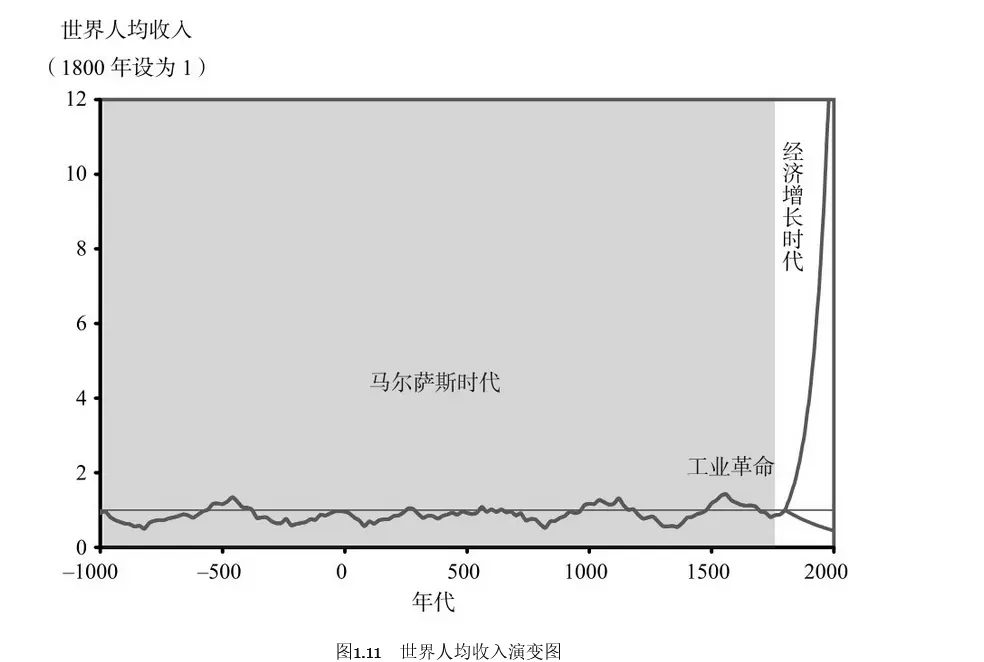
Human-Resource-Environment understands the Malthusian Trap from the perspective of natural resource utilization and population control, but in the field of economic growth and economic history research, we obtain other interesting data charts.
Before the Industrial Revolution, world per capita income remained almost unchanged, while after the Industrial Revolution, development experienced exponential growth.
In the long history of economic growth, it seems only one thing happened—the Industrial Revolution.
—— Gregory Clark (economist) (Gregory Clark)
Interesting Questions
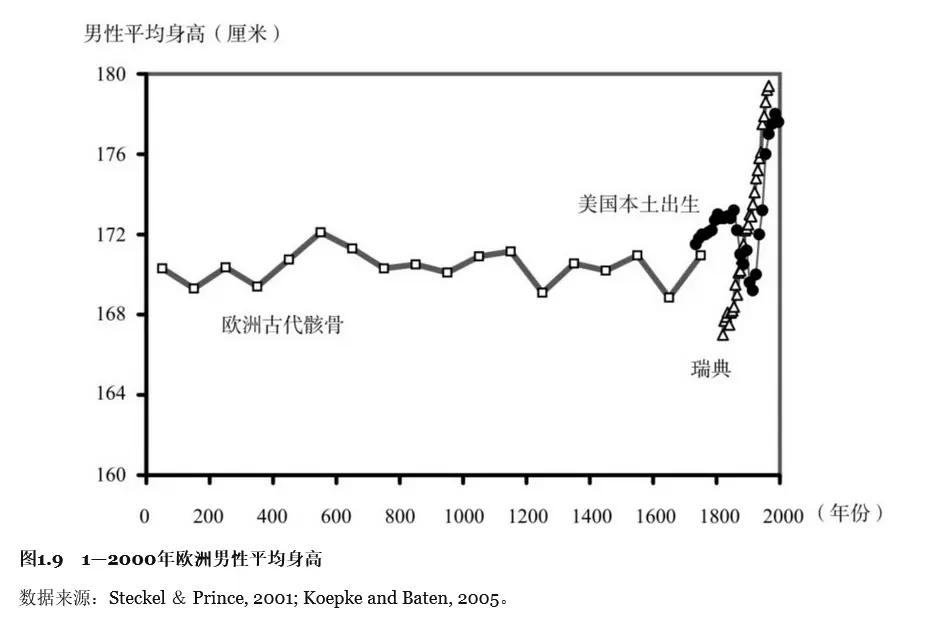
Seeing such historical trend charts inevitably raises the following questions:
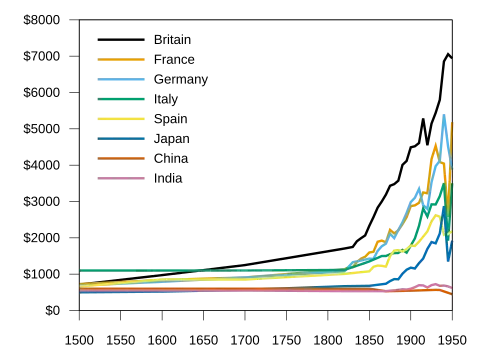
- Was the actual per capita income in the Ming Dynasty really the same as in the Song Dynasty?
- If prosperity was perfect, why couldn’t it be sustained?
- Why does history always oscillate between democracy and non-democracy?
Democratic Athens was defeated by authoritarian Sparta; after Western Rome came the Dark Ages.
- Why was the Industrial Revolution able to break the Malthusian Trap?
- Can a unified model describe the entire history of economic growth?
The extended discussion of unified economic growth models is quite fascinating. Initially, I found the Needham Question most interesting, stemming from the high school history teacher’s gift of The Gains and Losses of Economic Reforms Through the Ages2. My understanding of evolutionary theory owes thanks to Senior Z’s gift of The Selfish Gene 😍.
Personal reading notes on The Selfish Gene can be found at The Selfish Gene: The Question of Altruistic Morality.
Related issues: Needham Question3, Weber Question4, Great Divergence5…
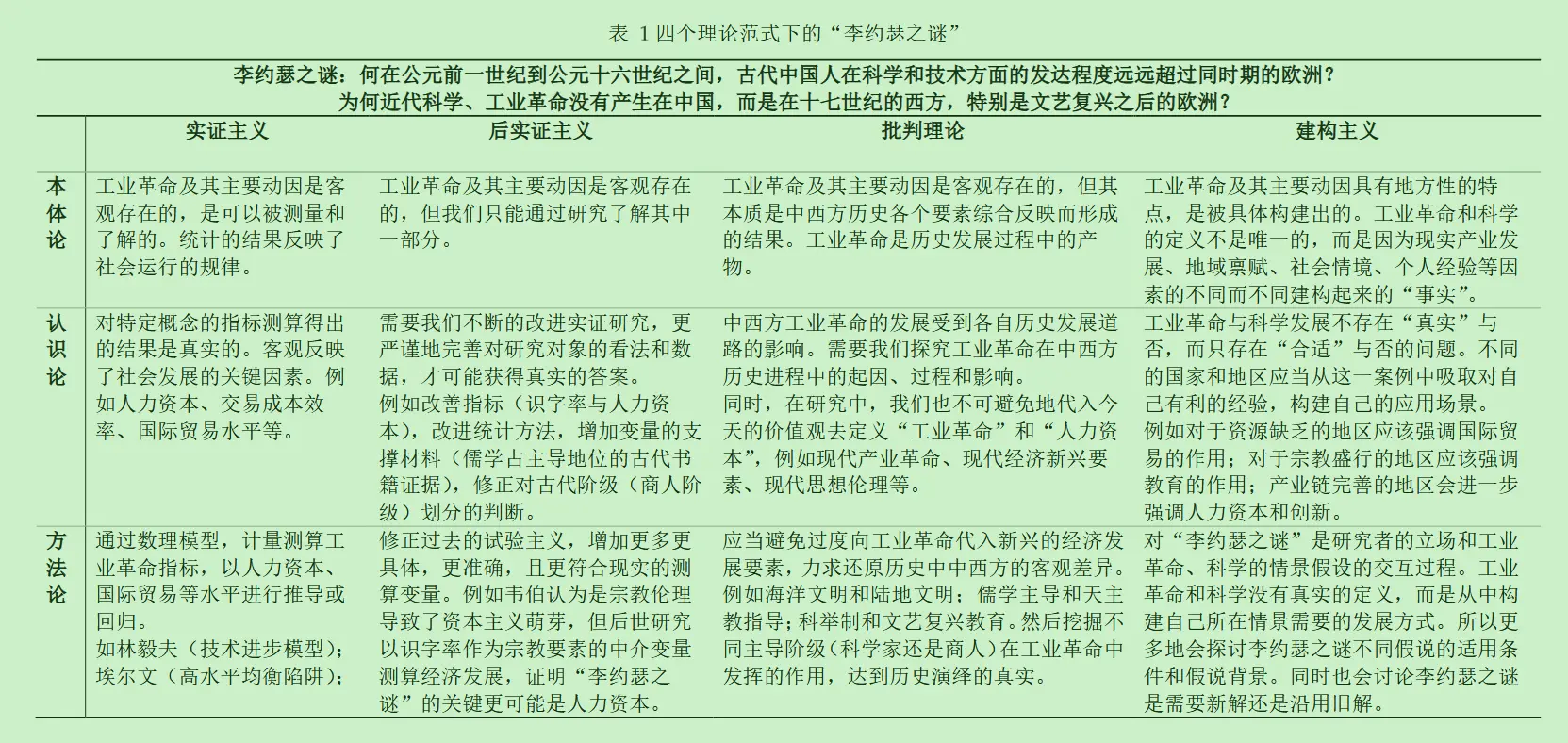
Three things need simultaneous explanation:
- Why were societies poor?
- What happened at the turning point?
- Why did societies become wealthy?
Selection
Here, I will only briefly illustrate The Origin of Wealth’s approach to answering these questions.
Two-Sector Malthusian Model and Luxury Goods
Traditional Malthusian theory is single-sector, focusing solely on reproduction versus survival (treating the production sector as monolithic).
This book employs a two-sector analysis, where individuals allocate resources between luxury goods and subsistence goods. The Malthusian population equilibrium line further constrains this allocation.
The added equilibrium is: equilibrium returns to the population equilibrium line. When population growth exceeds this line, per capita resources decline, manifested as proportional shrinkage of the production possibility curve.
The following diagram illustrates one scenario analysis:
When societal preference shifts toward luxury goods (indifference curves flatten). Equilibrium falls below the population equilibrium line (production possibility frontier expands). A new equilibrium emerges.
This theorem yields a counterintuitive economic insight: As social preferences shift toward luxury goods, social welfare paradoxically increases! The trade-off is temporary deviation from the population equilibrium line during transition.
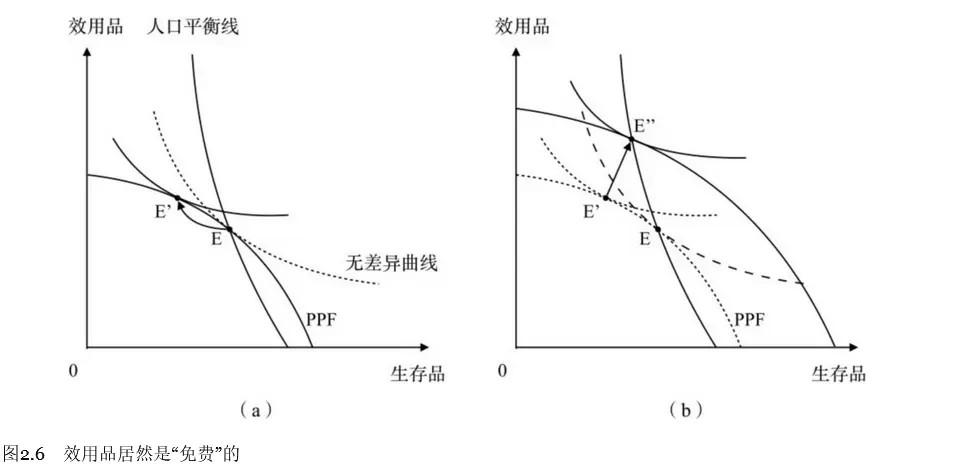
I find this two-sector refinement particularly elegant. Its conclusions resonate with historical patterns—as civilizations advance, artistic, aesthetic, and spiritual pursuits increasingly constitute luxury goods. Indeed, humanity’s valuation of goods transcending mere survival has steadily intensified.
Paradoxically, the pursuit of luxury goods may undermine civilizational reproduction. Consider sacrificing marriage for dreams, trading survival’s necessities for celestial aspirations, or compromising health for appearance.
The Origin of Wealth’s assumption about reproduction is: genes prompt us to care about genetic continuation, but we don’t specifically calculate reproduction probabilities.
This framework elegantly explains the paradoxical coexistence of wealth explosions with fertility declines, despite genuine living standard improvements6. While many attribute this to rising child-rearing costs, The Origin of Wealth’s framework reveals deeper dynamics—education, housing, healthcare, once survival necessities, are now transformed by consumerism into luxury goods. This metamorphosis of subsistence goods into luxury goods dramatically enhances social welfare, but at the expense of overall reproductive inclination7.
Population Funnel
The author’s model-calculated balanced growth path is:
$$ g_{social welfare}=\beta(g_{luxury goods}-g_{subsistence goods}) $$
In economic growth (macroeconomics) research, $g$ generally represents growth rate. The balanced growth path is the growth rate change process derived from the model solution.
During the Malthusian era, stagnant per capita income implies that, in this equation, luxury goods and subsistence goods sectors must have progressed at identical rates.
The greatest difficulty is that commercial and industrial sectors naturally progress more easily than agriculture.
This is also where I cannot be fully convinced by the author. This section serves as the transition connecting economic analysis with evolutionary game analysis.
The author uses population migration and regional trade as explanations:
- As previously established: heightened preference for luxury goods elevates social welfare.
- This attracts population influx, contracting the production possibility frontier.
- Equilibrium eventually restores.
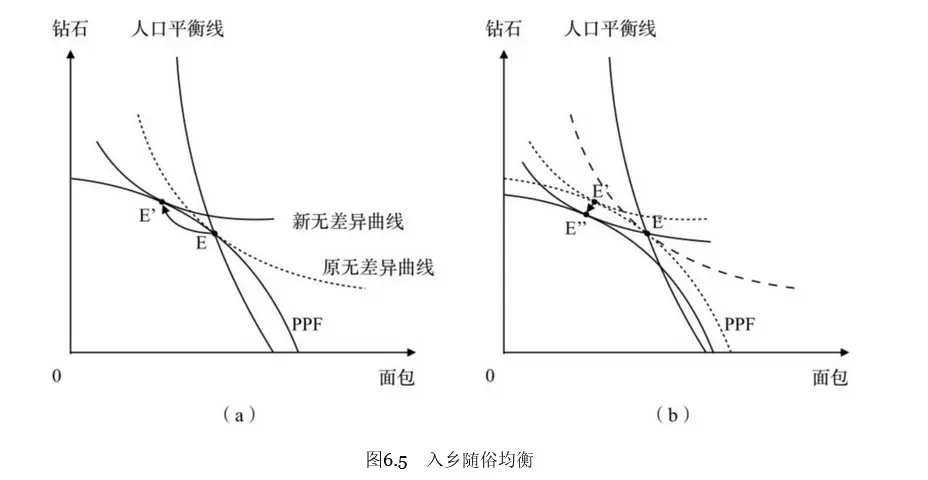
This seems to also accommodate the Lewis Turning Point. It also explains why people always migrate from places with simple, honest customs to places of extravagance and indulgence.
Group Selection
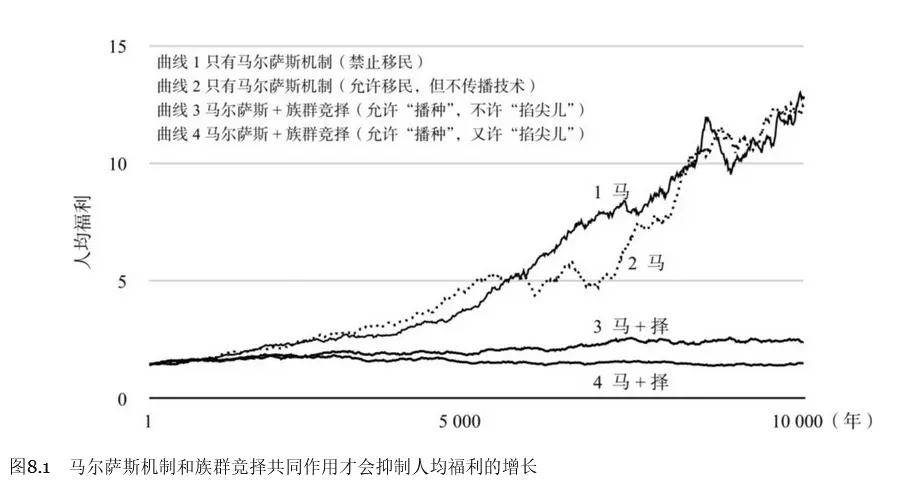
Mainstream views attribute the Malthusian mechanism to “limited resources,” while The Origin of Wealth identifies group selection (structural characteristic elimination) as the primary cause.
From an evolutionary perspective, competition between individuals and collectives may be contradictory.
The following equation is a nonlinear Volterra equation system. Originally describing lake-bottom ecosystems—big fish eat small fish, but when small fish are depleted, big fish also struggle to survive, ultimately reaching equilibrium.
$$ \begin{cases} \dot{\varepsilon}=-{\varepsilon }h\left( \theta \right)\\ \dot{\theta}=-{\theta }g\left( \varepsilon \right) \end{cases} $$
Therefore, the Neo-Cambridge School believes this equation resembles class struggle, interpreting it as the relationship between wage-output ratio and employment rate.
But its explanatory significance is far more profound—the natural philosophy of mutual rise and fall is vividly embodied in this equation.
For example, in today’s economy, everyone considers civil service the iron rice bowl, the safest choice. But if most people think this way, society loses wealth creation momentum, leading to collapse. The Keynesian liquidity trap follows similar logic.
The Selfish Gene argues genetic competition best explains evolution. But this equation refutes this—in fact, mainstream biology also recognizes group competition plays a significant role in evolution.
For example, within a species, each individual enhances reproductive organs or other conspicuous mating functions to achieve genetic transmission.
But intra-group competition, viewed from inter-group competition, represents internal consumption.
Cretaceous ostracod fossil evidence indicates—only populations with moderate reproductive organ length could persist. Longer reproductive organs actually lowered persistence probability8.
Take Athens as an example: highly developed civilization, implementing democratic institutions, yet unable to withstand attacks from authoritarian Sparta. The reason: Athenian democracy increased luxury goods—art, oratory, democracy, literature—but didn’t enhance subsistence goods—military, agriculture, architecture. Thus, this prosperity attracted enemies’ covetousness without strengthening resistance capabilities.
From this perspective, I believe The Origin of Wealth accommodates Why Nations Fail, even explaining why inclusive institutions fail in early stages.
Also demonstrates the uselessness of time travelers 😄.
In summary, if the luxury goods sector significantly outpaces the subsistence goods sector in growth, it becomes vulnerable to attack. Similarly, consider China’s Song Dynasty.
This explains why evolution hasn’t made everyone morally superior. Like the Dark Forest in The Three-Body Problem9, malice becomes a survival good in group selection games.
Thus we reach a conclusion—globally, subsistence goods and luxury goods grow at nearly identical rates.
Unified Theory
The previous section explained why per capita income stagnated during the Malthusian period. This section explains why wealth accumulation began after the Industrial Revolution.
Current Unified Theories
Generally, pre-Industrial Revolution stagnation is attributed to the Malthusian Trap, while later growth stems from endogenous technological progress. Most unified models explain this from population structure or factor scarcity perspectives.
Jones (2001)’s theoretical model uses population structure as the bridge. The Malthusian Trap assumes wealth leads to reproduction, but reality shows societies reduce fertility beyond certain wealth levels. Technology reinforces this trend, with the Industrial Revolution as the turning point10.
Galor and Weil (2000)’s model contains two trade-offs: 1. Pleasure vs. child-rearing—raising children sacrifices personal pleasure. 2. Fertility vs. child-rearing—equilibrium between reproductive returns and rearing costs11.
Galor and Moav (2002) strengthen education accumulation’s role based on previous work. Connecting the Industrial Revolution, education, and genetic selection theory accumulation12.
This is a 2002 QJE paper. Apparently, evolutionary theory and economics were linked long ago. Tracing further back, Malthus’s An Essay on the Principle of Population itself inspired Darwin. Malthus’s Essay and Darwin’s Origin of Species also inspired Marx’s Das Kapital.
Hansen and Prescott (2002) attempt technological transition explanations. Early productivity scarcity meant reliance on land as production factor. Post-Industrial Revolution, technological progress replaced land exploitation, enabling explosive wealth growth13.
The Origin of Wealth’s Explanation:
Clouds disperse, sunlight emerges. Most attempt to explain the sun’s emergence from nothingness.
But what if the sun always existed?
Consider Liu Cixin’s Ball Lightning—not ball lightning emerging from nothingness, but its camouflage disappearing14. Not the sun moving, but Earth rotating. Many believe happiness emerges from nothingness, but happiness might be relief from suffering.
Not the sun emerging from nothingness, but clouds disappearing from existence.
Three factors dispersed the clouds obscuring economic growth.
- Trade replaced migration
- Knowledge media revolution
- Utility goods explosion
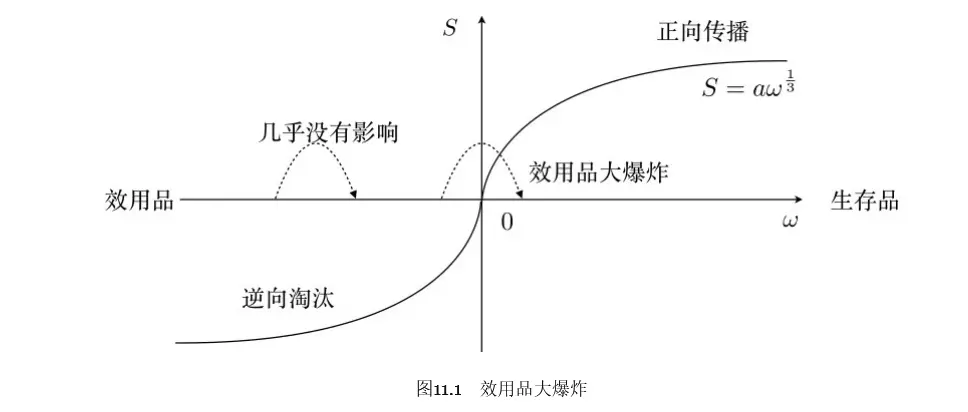
Meaning: economic growth, luxury goods pursuit, welfare improvement never ceased. But before the Industrial Revolution point, the strong perished. For example, prosperous Song Dynasty, Athens, Roman Empire. They developed only biological conspicuous characteristics—advantages in intra-group competition, not inter-group competition advantages.
Today, competition is multi-layered. Survival goods and luxury goods can transform synchronously; manufacturing and national defense are closely linked. Historically, excessive luxury goods development hindered progress; today, luxury goods development propels advancement. Just as China’s feudal system surpassed slavery but ultimately hindered modernization. Previous analyses stopped at life cycle theory; this book provides more detailed analysis from luxury goods perspective.
A dam’s hole is blocked, species on both sides mutate, the hole reopens, both sides combine, creating a third species. One species becomes three. To which cause should this change be attributed?
The perspective from which we examine emergence-from-nothingness processes is crucial.
In world prosperity, the selection index is that hole.
Market Fragility and Resilience
Continuing questioning: Why did the Soviet Union still collapse after the Industrial Revolution?
Competition is multi-layered, long-term.
- Rural subsistence goods may become urban luxury goods. For example, grassland dairy farms, rural organic produce.
- Today’s luxury goods may become tomorrow’s subsistence goods. Like historical aluminum and copper—with technological development, their exchange value with gold changed.
US and USSR competed at the same level; fascist vs. non-fascist competition also occurred at one level. As economies develop, competition victory effects magnify. Therefore, if the backward side overwhelms the other, dark rule persists longer. The sad conclusion: eternal prosperity doesn’t exist, but new prosperity always emerges.
- Prosperity always exists—this is the market’s resilience.
- Prosperity isn’t eternal—this is the market’s fragility.
Domestic history textbooks similarly describe ancient small-scale peasant economies.
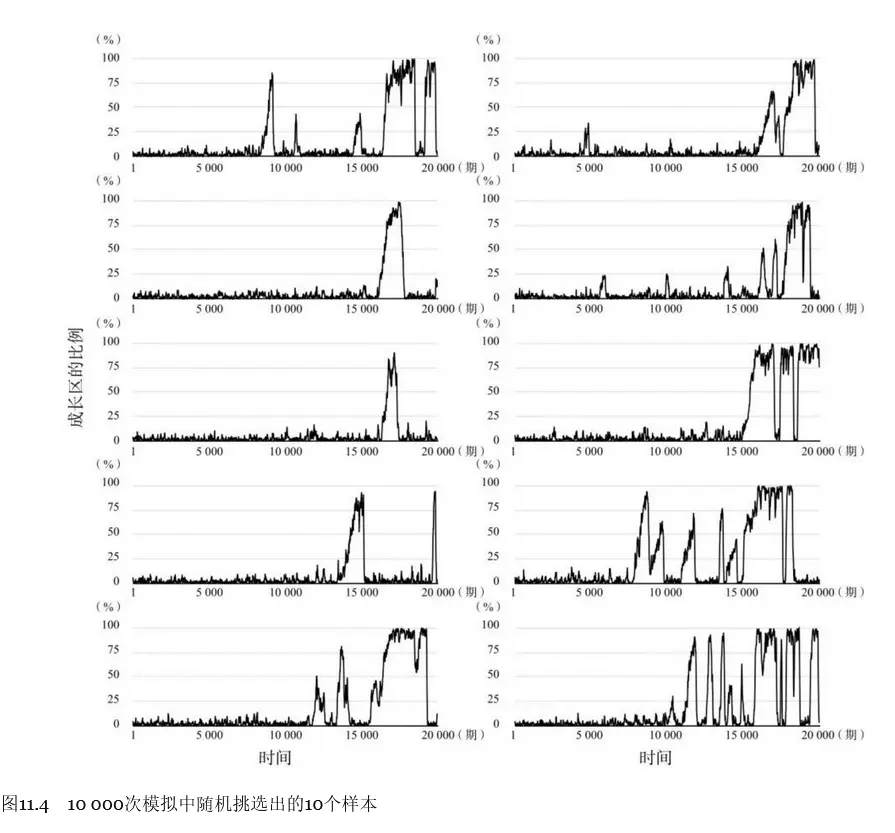
In other words, prosperity development always existed, but its diffusion was suppressed. Only when the world economy reached certain development levels could superior institutions diffuse. Wasn’t the Age of Discovery the key unlocking the Industrial Revolution?
Economic History’s Explainability
Historical Perspective
I agree with the author’s view of science—initially incredible, but after analysis, seemingly inevitable. This inevitability constitutes “science.”
This is why I find economic growth studies fascinating—model mathematics, economic intuition, historical accumulation all integrated. Macroeconomic speculation is indeed speculative. Involving nations, everyone seeks “unification”—one theory accommodating diverse development histories. From this perspective, economic growth cares more about goodness-of-fit than econometrics 🤧.
Microeconomics seeks optimization, econometrics seeks credibility, macroeconomics seeks what? I can only summarize this feeling as “big-picture perspective.”
When we realize economic growth is but a brief moment in historical rivers, while stagnant equilibrium constitutes history’s majority, we alleviate real-world anxiety. Tranquility endures, cosmic extinction is destined, but life cycles endlessly, continuously regenerating. Ultimately, this book’s philosophy aligns with The Lion King, 21 Lessons for the 21st Century, Wisteria Waterfall15.
Adam Smith’s The Theory of Moral Sentiments stated “humans pursue inner tranquility and pleasure.” Once abandoning being happy pigs to become suffering humans, we embark on this journey seeking inner peace. Isn’t this also pursuing luxury goods? 👨🎓
Personally, for knowledge seekers, historical explainability’s tranquility and inclusiveness are more precious than economics’ predictive power and practicality. Mencius said: I am good at cultivating my noble spirit. With knowledge, one embraces all phenomena, constantly striving. Unmoved when Mount Tai collapses before one’s eyes, undistracted when elk frolic leftward. I think—before cultivating academic spirit, one should cultivate personal spirit! This concerns fundamental vs. instrumental debate—remember the gentleman is not a vessel.

Limitations
Like Sapiens, The Selfish Gene understanding the world through evolution—broadly evolutionary theory—shares common ground with Hayek’s spontaneous order. Similarly, as evolutionary perspective extension, The Origin of Wealth shares with these books a “de-anthropocentric” angle. Consequently, I believe this book still has following issues:
Two-sector vs. single-sector model debate. Precisely because population structure changes slowly16 with long-term inertia, Malthusian single-sector analysis aligns better with intuition. Since luxury goods and subsistence goods easily transform, specific characterization analysis presents difficulties. This book only intuitively describes luxury goods. What exactly is the relationship between luxury goods and genetic survival? If related to selection, how can transformation be so easy?
Model assumptions. The model uses Cobb-Douglas production function—would growth paths differ using increasing returns to scale functions? After all, this is mainstream motivation for international trade.
Empirical methods. The author also analyzes selection theory as tautological17. Unlike mainstream counterfactuals for same objects, this book’s method involves computer simulation of growth scenarios and seeking non-biological counterfactuals—undeniably completely different from contemporary economics’ mainstream methods. Utility sector economic growth rates and survival sector economic growth rates still lack mainstream econometric estimation strategies18.
The author considers tautological definition-deduction as axiomatic discussion, neither self-proving nor requiring proof.
Organizational agency: The Selfish Gene separately establishes memes, distinguishing natural and human societies. Applying evolution theory to social analysis offers fresh perspective but must address agency questions—for example, whether government structure and evolution are mutually causal, then definitely not unilateral evolution problem. What does organizational construction mean for luxury goods and subsistence goods development? In long human societal development, only morality and state appear formally inevitable.
Personally, I quite like this evolutionary historical perspective. When trends fade, heroes exist but no stage; when trends prevail, sometimes heroes abound, sometimes mediocrity ascends, all creatures compete freely under frosty sky. Contingency, necessity, all compatible.
Conclusion
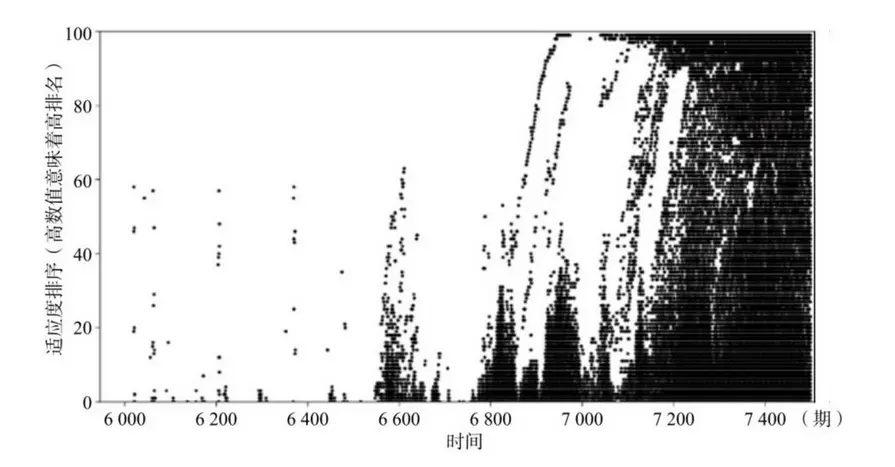
Returning to the point, The Origin of Wealth constructs a macroeconomic history understanding framework based on group competition and Malthusian two-sector model. The author uses sparks igniting prairie fire metaphor for economic evolution from dormancy to fluctuation. Civilization’s prosperity opportunities never ceased, lacking only appropriate external conditions.
However, the author doesn’t fully explain why post-Industrial Revolution era still witnesses backward civilizations defeating advanced ones. The latter half’s logical exposition lacks the first half’s smoothness. Still, this framework remains highly inclusive.
I summarize this historical perspective in three phrases:
- Pre-Malthusian: The outstanding tree attracts the wind’s destruction.
- Malthusian transition: A thousand years of darkness, one lamp illuminates all.
- Post-Malthusian: East wind borrows momentum, sparks ignite prairie fire.
-
This phrase originates from The Three-Body Problem (Dark Forest). In The Three-Body Problem, described as from Blaise Pascal. But based on online discussions, Pascal’s writings only contain similar-meaning paragraphs or long sentences. Generally considered semi-fabricated by Liu Cixin. ↩︎
-
This book discusses economic cycle theory, arguing modern Chinese economy continues ancient thought. When national advance-retreat theory was popular, this book followed similar tone. ↩︎
-
Despite China’s many important contributions to human technological development, why didn’t the Scientific and Industrial Revolutions occur in modern China? ↩︎
-
Why didn’t Eastern societies like China and India embark on rationalization paths independent of the West in political, economic, scientific, and artistic fields? ↩︎
-
The Western world overcame growth limitations in the 19th century, surpassing previously dominant or comparable Middle Eastern and Asian civilizations. ↩︎
-
Does this also讽刺赛博朋克的内核站不住脚?In Marxist political economy, this topic is called human alienation. ↩︎
-
Perhaps considered intergenerational cost. ↩︎
-
Höglund J, Sheldon B C. The cost of reproduction and sexual selection[J]. Oikos, 1998: 478-483. ↩︎
-
Assuming an advanced civilization discovers a primitive civilization, to prevent being attacked first, optimal game strategy is attacking first. ↩︎
-
Jones C I. Was an industrial revolution inevitable? Economic growth over the very long run[J]. The BE Journal of Macroeconomics, 2001, 1(2): 153460131028. ↩︎
-
Galor O, Weil D N. Population, technology, and growth: From Malthusian stagnation to the demographic transition and beyond[J]. American economic review, 2000, 90(4): 806-828. ↩︎
-
Galor O, Moav O. Natural selection and the origin of economic growth[J]. The Quarterly Journal of Economics, 2002, 117(4): 1133-1191. ↩︎
-
Hansen G D, Prescott E C. Malthus to solow[J]. American economic review, 2002, 92(4): 1205-1217. ↩︎
-
In Liu Cixin’s novel, ball lightning is a macro-atom difficult to observe with naked eyes, only noticeable when reacting with lightning. ↩︎
-
Middle school text. I remember vividly because during class, teacher asked Wisteria Waterfall’s theme; I happened to recall and answered correctly, deepening the impression. ↩︎
-
For example, Dragon Year baby boom results from long-term superstition and population structure interaction, cyclical, with enormous inertial force. ↩︎
-
From Zhang Wuchang—some definitions relying on description cannot self-prove, e.g., four-legged insect is insect with four legs. ↩︎
-
The Origin of Wealth’s methodological paradigm more resembles biology, public health, computational social science statistical paradigms—simulation modeling. ↩︎