
The Origin of Rich Species: A Lamp Can Light a Room Dark for a Thousand Years

Give civilization to time, rather than giving time to civilization1
—— The Dark Forest
Why I recommend it
The Origin of Rich Species reconstructs a history of economic growth through a two-sector Malthusian model plus competitive selection theory.
The Selfish Gene inspired the author to read economic history through evolution, while The Three-Body Problem inspired him to look for counterfactuals through science fiction and formal models. What they share is that both rely on game theory and evolutionary thinking:
I think Zhao Dingxin’s Zhao Dingxin | Structural-mechanism explanations and the development of structural-mechanism relations after the Big Bang does a very good job summarizing what Malthus leaves out:
The Malthusian equation describes the exponential relationship between the individual reproduction rate of a biological population and the growth of the population as a whole. But that relationship only fully holds under conditions where food is never scarce, there is no intra- or inter-species competition, no predators, no density-constrained disease, and no migration.
The Origin of Rich Species is precisely an attempt to revise Malthus from the angle of intra-group and inter-group competition.
Within the interpretive framework of the competitive-selection mechanism, the turning points of technological explosion and wealth growth, as well as history’s recurring cycles of prosperity and destruction, all receive a more inclusive explanation.
Challenging the academic mainstream is obviously hard. Beyond its theoretical models, the book also reflects on scientific concepts and methodology. I have always felt that — the best social scientists are really selling a worldview.
The Origin of Rich Species reaches that level. It builds a historical vision by bringing together evolutionary theory, economic phenomena, and historical context. Because the author clearly loves science fiction and popular science writing, the book is also a lively, genuinely fun read.
Like The Selfish Gene, this book feels less like a standard monograph and more like a modeling handbook for bioeconomics. The author walks through the wrong turns he once took and the way the argument of the paper gradually came together. That mix of courage against the mainstream, tight logic, and solid academic training is something I genuinely admire.
Economic history under the traditional Malthusian framework
What Malthus created was not just a discipline, but a way of telling history.
The Malthusian trap
Malthusian population theory gave rise to the field of population, resources, and environment.
- When society gets richer, people have more children;
- when society gets poorer, people have fewer children.
- In the end, per capita income stabilizes at a certain level.
- By the same logic, if production growth cannot keep up with population growth, disaster follows.
The history of economic growth
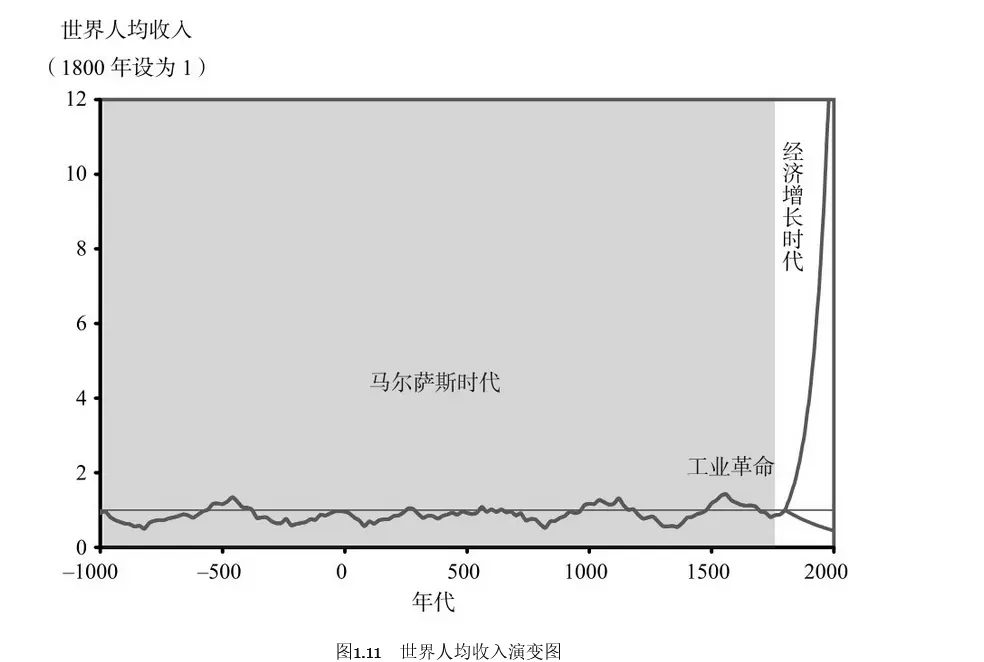
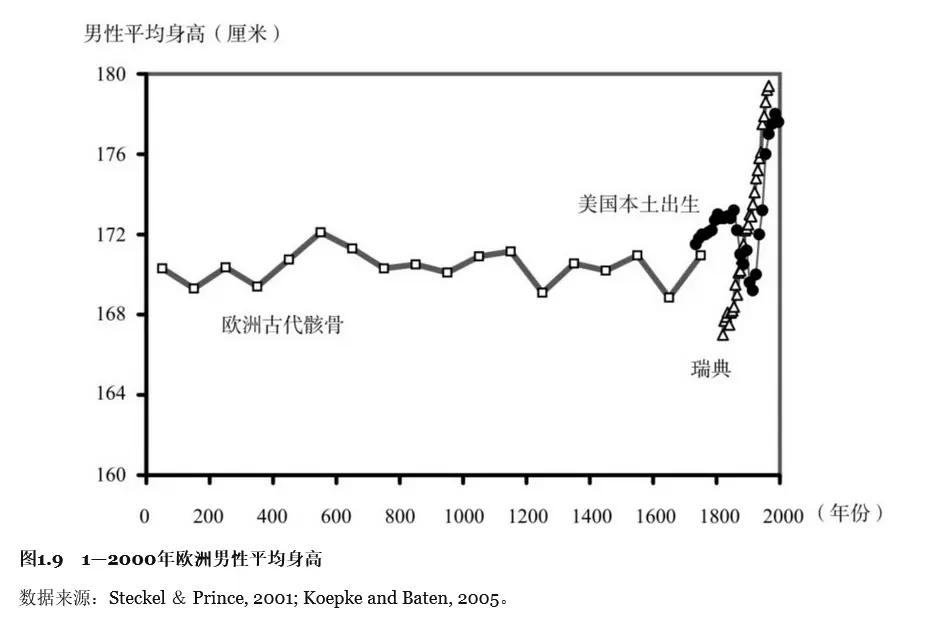
Population-resources-environment studies approach the Malthusian trap through natural resource use and population control. But once you move into economic growth and economic history, you get a different set of striking charts.
Before the Industrial Revolution, world per capita income was almost flat. After the Industrial Revolution, growth turned exponential.
In the long history of economic growth, it seems that only one thing ever happened — the Industrial Revolution.
—— Gregory Clark (Gregory Clark)
Interesting questions
When you look at historical trend charts like these, a few questions naturally come up:
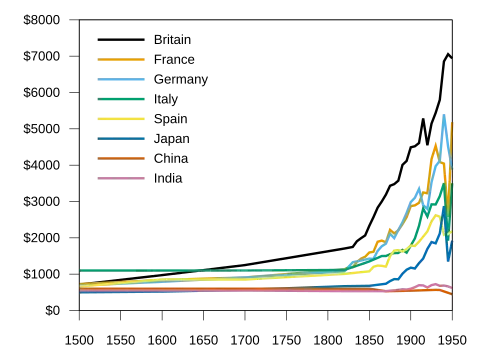
- Could the Ming dynasty really have had the same real per capita income as the Song dynasty?
- If prosperity were perfect, why could it not last?
- Why does history keep swinging between democracy and non-democracy?
Democratic Athens was defeated by authoritarian Sparta; the Western Roman Empire was followed by the dark medieval centuries.
- Why could the Industrial Revolution break the Malthusian trap?
- Can one unified model describe the whole history of economic growth?
The extended discussion around unified growth models is fascinating. At first, the most interesting issue to me was the Needham Question, which came from a high school history teacher who gave me The Gains and Losses of Economic Reform Through the Dynasties2. As for evolution, I owe that interest to senior Z, who gave me The Selfish Gene 😍.
For my own reading notes on The Selfish Gene, see The Selfish Gene: The Question of Altruistic Morality.
Related questions: the Needham Question3, the Weber Question4, the Great Divergence5……
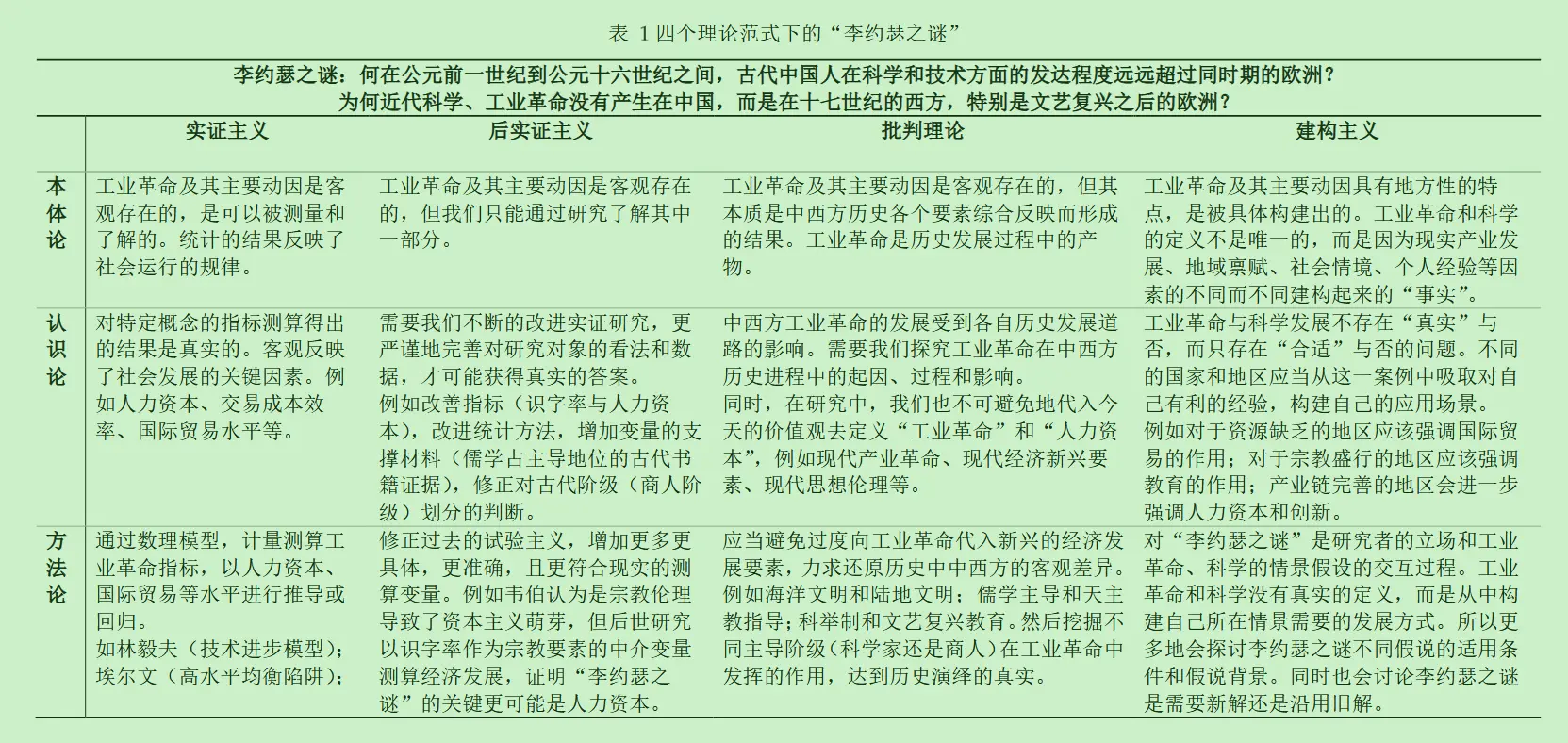
What has to be explained, all at once, are three things:
- Why are societies poor?
- What happened at the turning point?
- Why do societies become rich?
Competitive selection
Here I will only sketch, in very simple terms, the book’s way of answering those questions.
The two-sector Malthusian model and utility goods
Traditional Malthusian theory is single-sector. It only compares fertility and survival, treating the means-of-production sector as one whole.
This book uses a two-sector analysis. People choose between utility goods and subsistence goods. On top of that, the Malthusian population-equilibrium line still matters.
The additional equilibrium is this: the system returns to the population-equilibrium line. When population growth exceeds that line, per capita resources fall, which shows up as a proportional inward shift of the production possibility frontier.
The figure below presents one of the scenarios:
People’s preference for utility goods rises (the indifference curve becomes flatter). At that point equilibrium lies below the population-equilibrium line (the production possibility frontier expands). A new equilibrium is eventually formed.
In economic terms, this theorem is almost shocking: social preferences change, people value utility goods more, and social welfare somehow rises! The price is a temporary deviation from the population-equilibrium line.
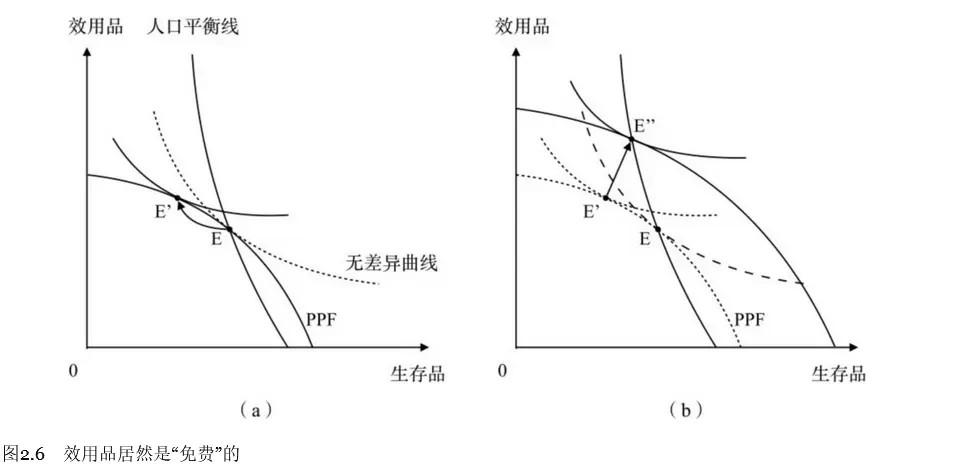
I really like this two-sector improvement. Its conclusion also fits the long historical trend. As history advances, art, beauty, and spiritual pursuits can all be treated as utility goods, and human civilization has in fact placed steadily more weight on things beyond mere survival.
At the same time, the pursuit of utility goods may conflict with the reproduction of civilization itself. People give up marriage to chase a dream; they abandon the fivepence of survival for the moon in the sky; they mistreat their bodies in pursuit of beauty.
The Origin of Rich Species makes the following assumption about reproduction: genes push us to care about their continuation, but we do not deliberately calculate the probability of reproduction.
This also helps explain why explosive wealth growth and falling fertility seem to move together, even though our living standards are genuinely improving 6. Many people reduce the reason to child-rearing costs, but the framework of The Origin of Rich Species can absorb that point too: education, housing, and medical care, all of which count as subsistence goods, have today been turned by consumerism into utility goods. That conversion of subsistence goods into utility goods massively raises social welfare, but the price is weaker fertility on the whole7.
The population funnel
The balanced growth path calculated in the author’s model is:
$$ g_{社会福利}=\beta(g_{效应品}-g_{生存品}) $$
In research on economic growth (that is, macroeconomics), $g$ usually denotes a growth rate. The balanced growth path is the path of growth-rate changes implied by solving the model.
During the Malthusian era, per capita income did not change. In the equation, that means the rate of progress in the utility sector and the rate of progress in the subsistence sector should have been the same.
The biggest difficulty is that commercial and industrial sectors are naturally easier to improve than agriculture.
This is also where the author stops fully convincing me. It is the transition point between economic analysis and evolutionary-game analysis.
The author’s explanation relies on population migration and regional trade:
- The earlier two-sector model already suggested that when preference for utility goods rises, social welfare rises too.
- Population then flows in naturally, and the production possibility frontier shrinks again.
- The system eventually returns to a new equilibrium.
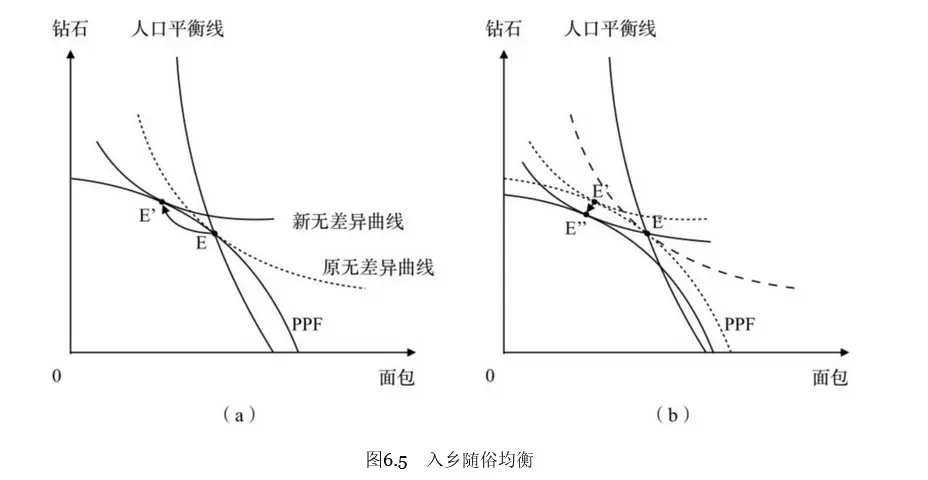
I feel this can also accommodate the Lewis turning point. It also helps explain why people are always moving from places with simple, modest customs to places marked by extravagance and excess.
Group competitive selection
The mainstream explanation of the Malthusian mechanism is “resources are limited,” while The Origin of Rich Species points instead to group competitive selection, that is, the structural elimination of certain traits.
From the perspective of evolution, competition at the individual level and competition at the collective level may well conflict with each other.
The system below is a nonlinear Volterra system. It was originally used to describe lake-bottom ecosystems: big fish eat small fish, but once the small fish are eaten out, the big fish also struggle to survive, and the system finally reaches equilibrium.
$$ \begin{cases} \dot{\varepsilon}=-{\varepsilon }h\left( \theta \right)\\ \dot{\theta}=-{\theta }g\left( \varepsilon \right) \end{cases} $$
That is why the New Cambridge school treated this equation like class struggle, reading it as the relationship between the wage share-output ratio and the employment rate.
But its interpretive force goes much further than that. The natural philosophy of one side rising as the other falls is expressed here with unusual clarity.
Take today’s economy. Everyone thinks becoming a civil servant is the iron rice bowl, the safest possible choice. But if most people think that way, society loses its drive to create wealth and starts to decay. Keynes’s liquidity trap works in a similar way.
The book The Selfish Gene argues that gene competition is the best explanation of evolution. But this equation pushes back against that claim. In fact, mainstream biology also holds that competition among groups plays a major role in evolution.
Take a species in which every individual strengthens its reproductive organs, or some other conspicuous mating trait, in order to pass on its genes.
Yet competition within a population becomes internal waste once you look at it from the perspective of competition between groups.
Fossil evidence from Cretaceous ostracods suggests that only populations with reproductive organs of moderate length were able to persist. The longer the organs, the lower the probability of long-term continuation8.
A concrete example: Athens had an extraordinarily advanced civilization and practiced democracy, yet it failed to withstand the attacks of authoritarian Sparta. The reason is that Athenian democracy increased utility goods — art, rhetoric, democracy, literature — but did not improve subsistence goods — military capacity, agriculture, architecture. That prosperity attracted enemies, but it did not strengthen the means to resist them.
From this angle, I think The Origin of Rich Species can even absorb Why Nations Fail, and it may also explain why inclusive institutions could fail in their early stages.
It also suggests that time travelers would be useless 😄(
To sum up, if the utility-goods sector grows far faster than the subsistence-goods sector, it becomes easier to attack. The same can be said of China’s Song dynasty.
That is also why evolution did not make everyone morally noble. Just like the dark forest in The Three-Body Problem9, malice becomes a kind of subsistence good in the game of group competitive selection.
So we arrive at one conclusion: on a global scale, the growth rates of subsistence goods and utility goods are almost the same.
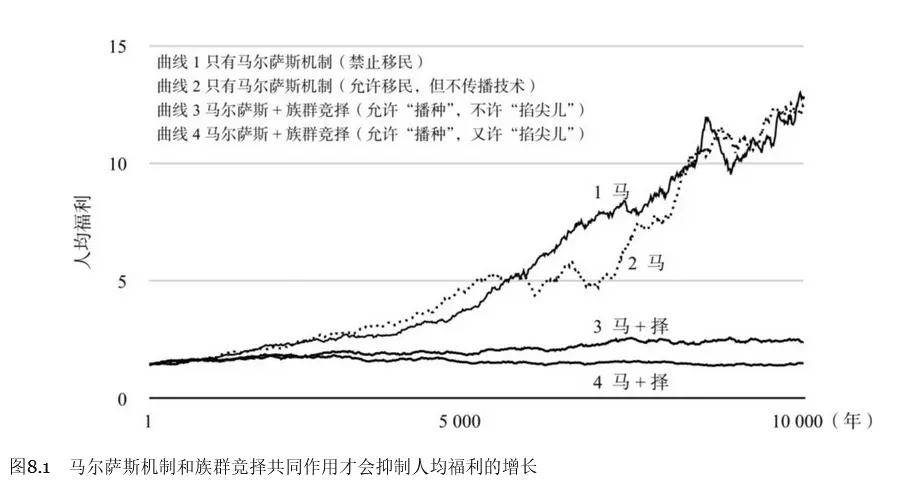
Unified theory
What came before explained why per capita income stayed stuck in the Malthusian age. What follows explains why wealth began to surge after the Industrial Revolution.
Existing unified theories
The standard view is that the pre-industrial world was ruled by the Malthusian trap, while the later period was driven by endogenous technological progress. Most unified-growth models explain the transition through either population structure or factor scarcity.
Jones (2001) builds a theoretical model that uses population structure as the bridge. The Malthusian trap assumes that when people get richer, they have more children, but in reality fertility falls once a society becomes rich enough. Technology strengthens that trend, and the Industrial Revolution was the turning point10.
Galor and Weil (2000) work with two trade-offs: 1. pleasure versus child-rearing, since raising children sacrifices one’s own enjoyment; 2. childbirth versus child quality. There is an equilibrium between the return to fertility and the cost of child-rearing11.
Galor and Moav (2002) strengthen the role of educational accumulation on that basis, linking the Industrial Revolution, education, and the accumulation implied by gene-selection theory12.
This was a 2002 QJE paper. So evolution and economics had already been linked long ago. Go back even earlier and Malthus’s Essay on the Principle of Population was itself an important inspiration for Darwin. Malthus’s Essay on Population and Darwin’s On the Origin of Species also inspired Marx’s Capital.
Hansen and Prescott (2002) try to explain the shift through technological transition. Early on, productivity was scarce and people depended on land as a factor of production. After the Industrial Revolution, technological progress replaced that dependence on land development, and wealth then grew explosively13.
The explanation in The Origin of Rich Species
When the clouds disperse, the sun comes out, and most people try to explain how the sun went from nonexistence to existence.
But what if the sun had always been there?
Take an analogy from Liu Cixin’s Ball Lightning: it is not that ball lightning appears out of nowhere; rather, its disguise goes from present to absent14. It is not that the sun moves, but that the earth moves. Many people think happiness is something brought into existence, but perhaps happiness is only the easing of pain.
It is not that the sun goes from absent to present, but that the clouds go from present to absent.
Three factors cleared away the clouds hanging over economic growth.
- Trade replaced migration
- Innovation in knowledge media
- An explosion of utility goods
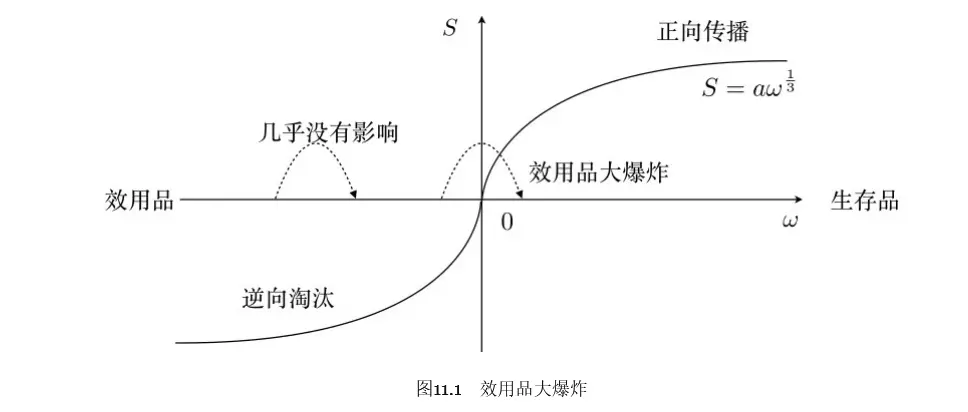
In other words, economic growth, the pursuit of utility goods, and gains in welfare never stopped. But before the Industrial Revolution, the strong were the ones who died. Think of the advanced Song dynasty, Athens, or the Roman Empire. What they developed were only the flashy traits of biological display — advantages in competition among individuals inside the group, not advantages in competition between groups.
Today competition works across many levels. Subsistence goods and utility goods can be transformed into each other at the same time; manufacturing and national defense are closely tied together. In the past, overdevelopment of utility goods was an obstacle. Today, the development of utility goods has become a driving force instead. Just as China’s ancient feudal order once stood ahead of slave society, yet in the end held back modernization. Earlier accounts usually stop at a lifecycle-theory explanation; this book goes further by dissecting utility goods in much finer detail.
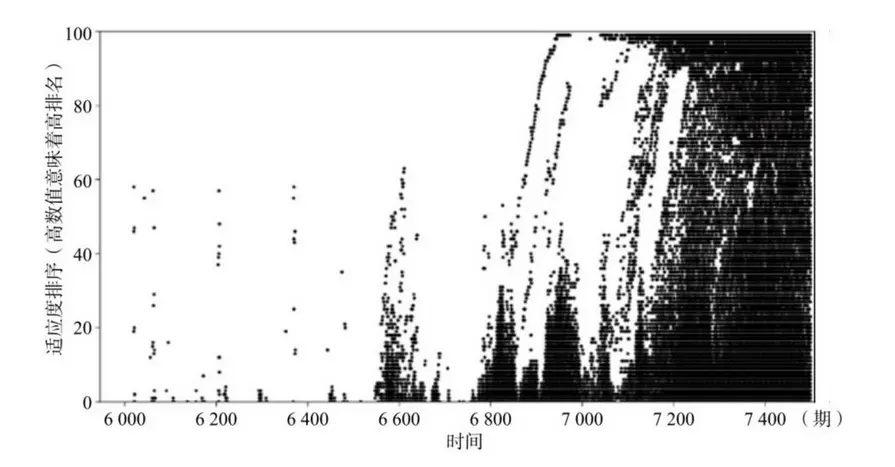
A hole in a dam is blocked. The species on the two sides mutate separately. Then the hole opens again, the two sides reunite, and a third species appears. One species becomes three. If that opening had never existed, it seems there would have been only one species forever. To what cause should we attribute the change?
The angle from which we look at a process of something coming into being matters enormously.
In the prosperity of the world, the competitive-selection index is that opening.
Market fragility and resilience
A further objection: if that is true, why did the Soviet Union still collapse after the Industrial Revolution?
Competition is layered, and it unfolds over long stretches of time.
- Rural subsistence goods may become urban utility goods. Think of prairie dairy farms or green fruit and vegetables from the countryside.
- Today’s utility goods may become tomorrow’s subsistence goods. Aluminum and copper once functioned that way in history; as technology changes, so does their exchange value relative to gold.
The United States and the Soviet Union were competing on the same level; fascist and non-fascist systems were competing on another level. The more developed an economy becomes, the larger the consequences of victory in competition. So if the backward side crushes the other, dark rule may also last longer. The sad conclusion is that eternal prosperity does not exist — but new prosperity keeps appearing.
- Prosperity always exists — this is the market’s resilience.
- Prosperity is never eternal — this is the market’s fragility.
This is also how domestic history textbooks describe the ancient small-peasant economy.
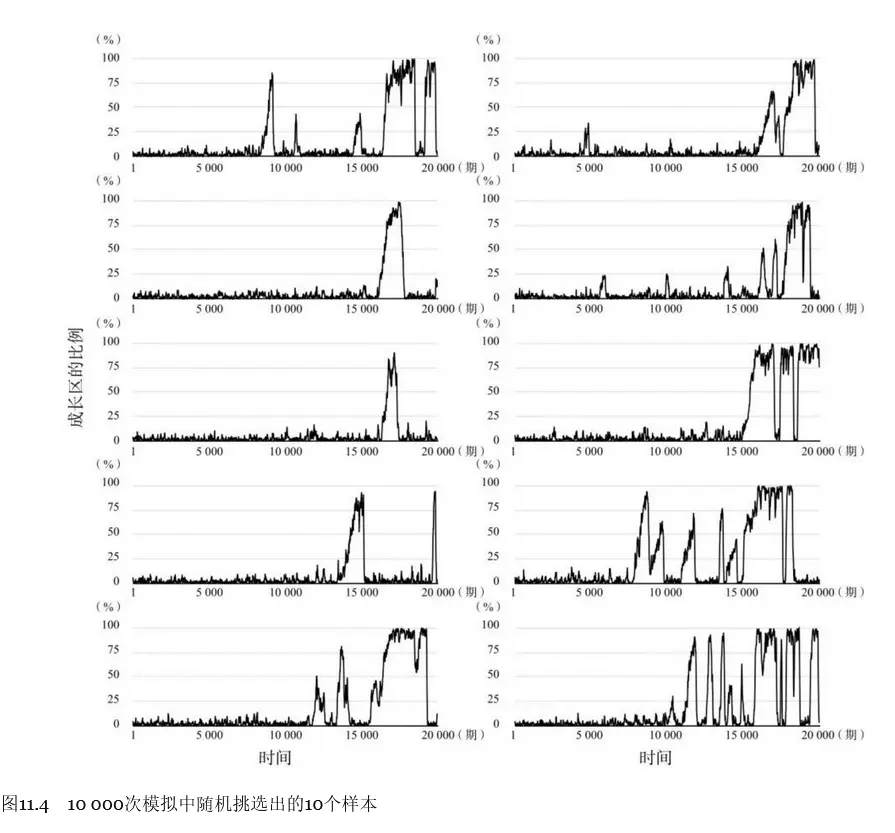
Put differently, the development of prosperity has always existed, but its diffusion has always been suppressed. Only when the world’s economy as a whole reached a certain stage did a good institution finally gain the chance to spread. Wasn’t the Age of Discovery precisely the key that opened the Industrial Revolution?
The interpretability of economic history
A philosophy of history
I agree with the author’s view of science in the book: at first glance it seems unbelievable, but after analysis it begins to feel as if it could not have been otherwise. That sense of “it had to be this way” is what I would call science.
That is also why I find economic growth almost unbeatable as a field: mathematical models, economic intuition, and accumulated history are all stitched together. Macroeconomics really does feel a bit like ritual dancing sometimes. Once nations are involved, everyone is chasing some kind of “grand unification” — one theory that can accommodate wildly different development paths. At that level, economic growth may care even more about goodness of fit than econometrics does 🤧.
Microeconomics seeks optimization; econometrics seeks credibility. What does macroeconomics seek? The only phrase I can think of is a view of the whole.
Once we realize that economic growth is actually the brief flare in the long river of history, while stagnant equilibrium makes up most of history’s surface, some of our real-world anxiety eases. Quiet permanence is always there, extinction may well be the end of the universe, yet life keeps cycling and renewing itself. In the end, the philosophy of this book is not so different from The Lion King, 21 Lessons for the 21st Century, and Wisteria Waterfall15.
Adam Smith wrote in The Theory of Moral Sentiments that “man pursues inner peace and pleasure.” Once you give up being a happy pig and choose instead to be a suffering human, you step onto that journey of seeking inner calm. Isn’t that too a form of pursuing utility goods? 👨🎓
In my own view, for anyone who really wants to understand the world, the calm and inclusiveness that come from history being interpretable are far more precious than economics’ predictive power and practical utility. Mencius said: I am good at cultivating my vast, flowing qi. Only by knowing something can one hold the myriad things with tolerance, strengthen oneself without rest, keep one’s face unchanged when Mount Tai collapses before one’s eyes, and not blink when a deer bolts to the left. I would say this: before academic spirit is cultivated, the human spirit itself probably needs cultivating first. This is a question of roots and branches — one must remember that the gentleman is not a mere tool.

Problems
Just as Sapiens and The Selfish Gene use evolution to understand the world, one can treat them as forms of broad evolutionary thinking — something that overlaps with Hayek’s spontaneous order. In that same sense, The Origin of Rich Species, as an extension of the evolutionary perspective, shares with those books a certain “de-anthropocentric” angle. For that very reason, I think the book still has the following problems:
The dispute between the two-sector model and the one-sector model. Precisely because changes in population structure are slow16 and carry long-term inertia, Malthus’s one-sector analysis fits intuition rather well. If utility goods and subsistence goods can so easily transform into one another, then describing them rigorously becomes a real problem. The book only gives a more intuitive description of utility goods. But what exactly connects utility goods to genetic survival? If the whole argument rests on competitive selection, how can this transformation be so easy?
Model assumptions. The production function in the model is Cobb-Douglas. I wonder whether the growth path would change if one used a function with increasing returns to scale instead. After all, that is one of the standard motives for international trade in mainstream theory.
Empirical method. The author also argues that competitive-selection theory is a tautological logic17. Unlike mainstream counterfactual analysis built around the same object of comparison, the method in this book relies on computer simulation of growth patterns and the search for non-biological counterfactuals. That is obviously very different from the dominant methods in contemporary economics. We still lack a mainstream econometric identification strategy for estimating the growth rate of the utility sector and the growth rate of the subsistence sector18.
The author argues that this kind of tautological definitional deduction can be treated as an axiomatic discussion: it cannot prove itself, and need not prove itself.
Agency of organized actors. The Selfish Gene separately sets up memes, distinguishing natural society from human society. Applying evolution to social analysis is a fresh perspective, but it also has to face the problem of agency. If the structure and evolution of government are mutually causal, then this is no longer a one-way story of evolution. What does the construction of an organization imply for the development of utility goods and subsistence goods? Across the long history of human society, only morality and the state seem to have become formally necessary elements.
Still, I do like this kind of evolutionary philosophy of history. When the tide goes out, there are stalwarts but no heroes on the stage; when the tide is in, heroes sometimes appear, and mediocrities sometimes do too. All things compete freely under the frosty sky. Contingency and necessity can both fit inside the same picture.
Conclusion
Stepping back, The Origin of Rich Species builds a framework for understanding macroeconomic history through group competition and the two-sector Malthusian model. The author uses a spark setting the prairie ablaze to describe the movement of economic evolution from silence to turbulence. The chance for civilizations to flourish has never disappeared; what was missing were the right external conditions.
Still, the author never fully explains why, even after the Industrial Revolution, backward civilizations can sometimes defeat more advanced ones. The logic in the second half is less smooth than in the first. Even so, the framework remains impressively inclusive.
I would sum up this view of history in three sentences:
- Before Malthus: a tree that rises above the forest is the first to be broken by the wind.
- In the Malthusian age: a lamp can light a room dark for a thousand years.
- After Malthus: with the east wind at its back, a spark can set the prairie on fire.
-
This line is from The Three-Body Problem (The Dark Forest). In the novel, it is described as coming from Blaise Pascal. But after looking through online discussions, I think Pascal only wrote passages or long sentences with a roughly similar meaning. Most people seem to agree that Liu Cixin partly invented this line. ↩︎
-
This book is about economic cycles and also argues that modern Chinese economics is in some sense a continuation of ancient ideas. At the time, debates over the advance and retreat of the state were very popular, and the book broadly shared that tone. ↩︎
-
Despite China’s many important contributions to the development of human science and technology in antiquity, why did modern science and the Industrial Revolution not arise in China? ↩︎
-
Why did Eastern societies such as China and India fail to follow a path of rationalization in politics, economics, science, and even art that was independent of the West? ↩︎
-
In the nineteenth century, the Western world overcame growth constraints and surpassed the formerly dominant, or comparable, civilizations of the Middle East and Asia. ↩︎
-
Could this also be mocking the shaky core of cyberpunk? In Marxist political economy, this topic is called human alienation. ↩︎
-
Perhaps it can be understood as an intergenerational cost. ↩︎
-
Höglund J, Sheldon B C. The cost of reproduction and sexual selection[J]. Oikos, 1998: 478-483. ↩︎
-
Suppose an advanced civilization discovers a less advanced one. To prevent itself from being attacked first, the optimal game-theoretic strategy is to strike first. ↩︎
-
Jones C I. Was an industrial revolution inevitable? Economic growth over the very long run[J]. The BE Journal of Macroeconomics, 2001, 1(2): 153460131028. ↩︎
-
Galor O, Weil D N. Population, technology, and growth: From Malthusian stagnation to the demographic transition and beyond[J]. American economic review, 2000, 90(4): 806-828. ↩︎
-
Galor O, Moav O. Natural selection and the origin of economic growth[J]. The Quarterly Journal of Economics, 2002, 117(4): 1133-1191. ↩︎
-
Hansen G D, Prescott E C. Malthus to solow[J]. American economic review, 2002, 92(4): 1205-1217. ↩︎
-
In Liu Cixin’s novel, ball lightning is a kind of macro-atom that is hard to observe with the naked eye and becomes noticeable mainly when it reacts with lightning. ↩︎
-
A middle-school text. I remember it so clearly because a teacher once asked in class what the theme of Wisteria Waterfall was, and I happened to know the answer, so the impression stuck. ↩︎
-
For example, the baby boom in a Year of the Dragon reflects the joint effect of long-term superstition and population structure: cyclical, repetitive, and powered by massive inertia. ↩︎
-
A term from Steven N. S. Cheung, referring to definitions that rely on description but cannot prove themselves, such as calling a four-legged bug a bug with four legs. ↩︎
-
The methodological paradigm of The Origin of Rich Species feels closer to the statistical paradigms used in biology, public health, and computational social science: simulation-based modeling. ↩︎