
Genshin Impact Probability: For Material Crafting, Should You Pick the 10% Double Output or the 25% Refund?
 滑翔闪 included in Economic Studies

Plenty of people online have already computed the expected value, but no one seems to have computed the variance, so I’ll fill that in here.
1. Setup
In Genshin Impact, three low-level materials can be crafted into one high-level material. We denote this as $a \xrightarrow{\text{转化}}\dfrac{b}{3}$
To keep units consistent, we uniformly use b for both input and output, assuming both sides start with initial material a, which is equivalent to $\dfrac{b}{3}$.
There are two talents, as shown below
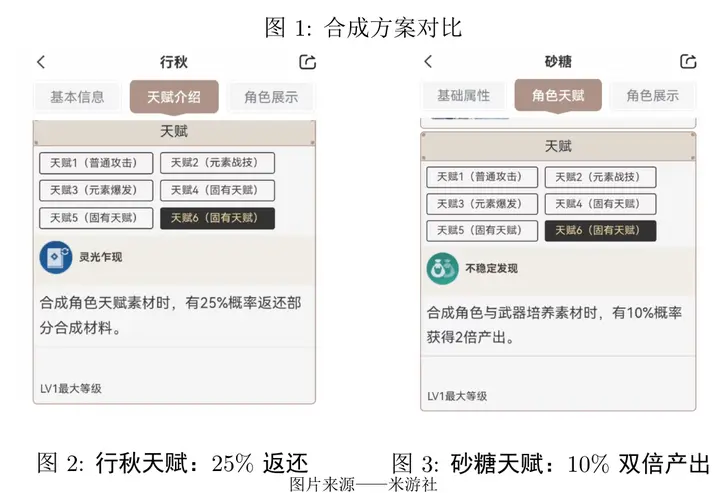
- One has a 10% chance of double output.
Each time you use a materials, i.e. $\dfrac{b}{3}$ material, there is a 10% chance of directly producing $\dfrac{2}{3}b$ material.
- The other has a 25% chance of refunding some low-level materials.
Each time you use a materials, i.e. $\dfrac{b}{3}$ material, there is a 25% chance of returning $\dfrac{1}{3} \times \dfrac{1}{4}b$ material.
In terms of a random variable, that is:
$$X_{总产出}=\frac{b}{3}+Y_{额外产出}$$2. Computing Expectation and Variance
Plenty of people online have already computed the expected value, but no one seems to have computed the variance, so I’ll fill that in here as well.
(1) Expectation and Variance of the 10% Double Output
1. Expectation
This is a binomial discrete distribution. 10% chance of double output, 90% chance of ordinary output.
As in Table 1:
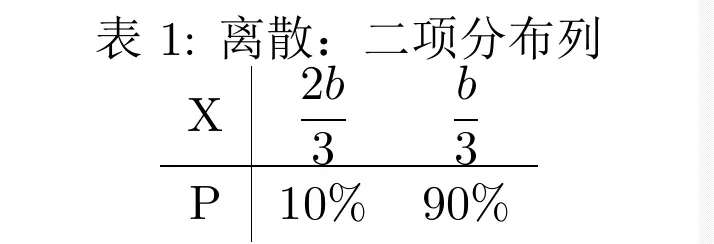
So investing a materials is equivalent to investing $\dfrac{b}{3}$ material, and the expectation of the 10% double talent is $E_{\text{双倍}}(\dfrac{b}{3})=\dfrac{11 b}{30} $ .
2. Variance
$$ \mathrm{Var}[X]=\mathrm{Var}[\frac{b}{3}+Y\_{额外产出}]=\mathrm{Var}[Y\_{额外产出}] $$$$ \mathrm{Var}[Y]=np(1-p)=\frac{b}{3}\times0.1\times0.9=\frac{3}{100}b $$So investing a materials is equivalent to investing $\dfrac{b}{3}$ material, and the variance of the 10% double talent is $Var_{\text{双倍}}(\dfrac{b}{3})=\dfrac{1}{100}b^2$.
(2) Expectation and Variance of the 25% Refund
1. Two ways to compute the expectation
Method 1: geometric series
$$ \begin{align*} E_{\text{返回}}\left(\frac{b}{3}\right) &= \frac{b}{3} + \frac{b}{3} \times 25\\% \times \frac{1}{3} + \ldots + \frac{b}{3} \times \left(\frac{1}{12}\right)^n \newline &= \frac{b}{3} \times (1+{\frac{1}{12}}+{\frac{1}{12}}^2+...+{\frac{1}{12}}^n) \newline &= \frac{b}{3} \times \frac{1 \times (1-{\frac{1}{12}}^n)}{1-\frac{1}{12}} \newline \end{align*} $$$$ \lim_{n\rightarrow + \infty}E_{\text{返回}}\left(\frac{b}{3}\right)=\frac{b}{3} \times \frac{1 \times (1-{\frac{1}{12}}^n)}{1-\frac{1}{12}}=\frac{4b}{11} $$The illustration is as follows:
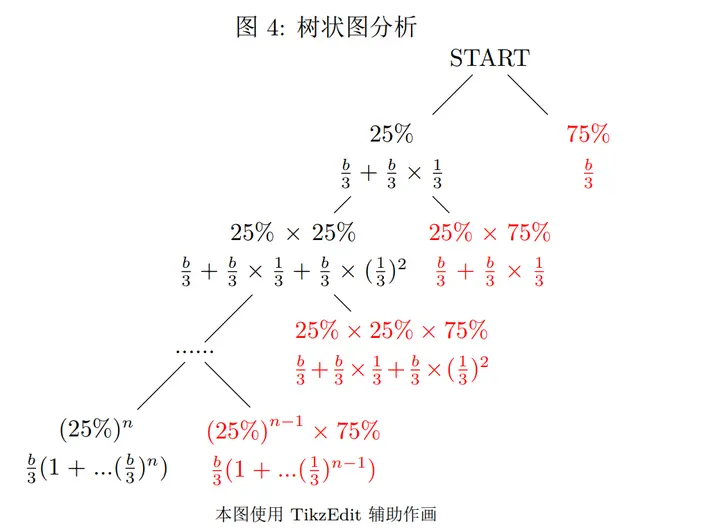
We can verify whether this classification has covered all cases by summing all the probabilities:
$$ \lim_{n\rightarrow +\infty}75\\%+...+{(25\\%)}^{n-1}75\\%=1 $$All the corresponding probabilities sum to 1, which to some extent verifies that this classification is correct.
Method 2: recursion
Because the refunded materials are refined again, a recursion forms, so we get:
$$ E_{\text{返回}}\left(\frac{b}{3}\right)=\frac{b}{3} +E_{\text{返回}}\left(\frac{b}{3}\right)\times 25\% \times \frac{1}{3} $$The answer is the same as above:
So investing a materials is equivalent to investing $\dfrac{b}{3}$ material, and the expectation of the 25% refund talent is $E_{\text{返回}}(\frac{b}{3} )=\frac{4b}{11}$.
2. Variance
The following approach to computing the variance comes from A More Refined Calculation of Whether to Pick the 10% Double or 25% Refund for the Material Crafting Talent
Now we continue by introducing a recurrence, and we have the following recurrence.
$$\mathrm{E}(a_k)=\mathrm{E}(a_{k-1})\times 25\% \times \dfrac{1}{3}$$Meaning:
Before the $k$-th craft, you have $a_k$ low-level materials in hand.
The condition for being able to do the $k$-th craft is: the $(k-1)$-th craft triggered the effect and refunded some low-level materials.
Using the law of total expectation, this is
$$ \mathrm{E}(a_k)=\mathrm{E}[\mathrm{E}[a_k| a_{k-1}]]=\mathrm{E}[\frac{1}{12}a_{k-1}]=\frac{1}{12}\mathrm{E}[a_{k-1}] $$$$ \mathrm{E}[X]=\sum_1^{k}a_k=\sum_1^{k}\frac{1}{12^k}a_0 $$This expression can be expanded as a recursion or as a geometric series — the two methods for computing the expectation above.
After introducing conditional expectation, next we introduce the variance decomposition formula:
$$ \mathrm{Var}[X]=\mathrm{E}[X^2]-[\mathrm{E}(X)]^2 $$Rearranging and adding conditional expectation, we can get two expressions involving $\mathrm{E}(X|Y)$.
$$ \mathrm{Var}[\mathrm{E}(X|Y)]=\mathrm{E}\left\\{\left[\mathrm{E}(X|Y)\right]^{2}\right\\}-\left\\{\mathrm{E}\left[\mathrm{E}(X|Y)\right]\right\\}^{2}=\mathrm{E}\left\\{\left[\mathrm{E}(X|Y)\right]^{2}\right\\}-\left[\mathrm{E}(X)\right]^{2} $$$$ \mathrm{E}[\mathrm{Var}(X|Y)]=\mathrm{E}\left\\{\mathrm{E}(X^{2}|Y)-[\mathrm{E}(X|Y)]^{2}\right\\}=\mathrm{E}(X^2)-\mathrm{E}\left\\{\left[\mathrm{E}(X|Y)\right]^2\right\\} $$Adding the two expressions above gives the variance decomposition formula:
$$ \mathrm{Var}(X)=\mathrm{Var}[\mathrm{E}(X|Y)]+\mathrm{E}[\mathrm{Var}(X|Y)] $$Substituting $a_k, a_{k-1}$ into this formula:
$$ \mathrm{Var}(a_k)=\mathrm{Var}[\mathrm{E}(a_k|a_{{k-1}})]+\mathrm{E}[\mathrm{Var}(a_k|a_{k-1})] $$where
$$ \mathrm{Var}[\mathrm{E}(a_k|a_{{k-1}})]=\mathrm{Var}[\frac{1}{12}a_{k-1}] $$$$ \mathrm{E}[\mathrm{Var}(a_k|a_{k-1})]=\mathrm{E}[np(1-p)]=\mathrm{E}[np(1-p)]=\mathrm{E}\left[\frac{a_{k-1}}{16}\right] $$We get:
$$ \begin{aligned}\mathrm{Var}\left[a_k\right]=\frac{3}{4} \frac{a_0}{12^k}+\frac{1}{12^2} \mathrm{Var}\left[a_{k-1}\right]\end{aligned} $$Since $\mathrm{Var}(a_0)=0$, using the recursion we get the general term:
$$ \mathrm{Var}[a_k]=\frac{9}{143}a_0\left(1-\frac{1}{144^k}\right)=a_0\times \frac{1}{16\times 144^{k-1}} $$$$ \mathrm{E}\left[a_k^2\right] = \mathrm{Var}[a_k] + \left(\mathrm{E}\left[a_k\right]\right)^2 =9\frac{k{a_0}}{12^{2k}} + \frac{a_0^2}{12^{2k}} $$I tossed it to GPT to compute and then verified it; it also satisfies the 144-fold relationship between variance terms:
Then we set the subsequent recursion to fuse $l$ times
$$ \begin{aligned} &\mathrm{E}\left[a_k a_\ell\right]=\mathrm{E}\left[\mathrm{E}\left[a_k a_\ell \mid a_\ell\right]\right]\\\\ &=\mathrm{E}\left[a_\ell \mathrm{E}\left[a_k \mid a_\ell\right]\right]\\\\ &=\frac{1}{12^{k-\ell}}\mathrm{E}\left[a_\ell^2\right]\\\\ &=\frac{9a_0^2l+a_0^2}{12^{k+\ell}} \end{aligned} $$This is to compute the covariance:
$$ \mathrm{Cov}(a_\ell, a_k) = \mathrm{E}\left[a_\ell a_k\right] - \mathrm{E}\left[a_\ell\right]\mathrm{E}\left[a_k\right]=\frac{9a_0^2\ell}{12^{k+\ell}} $$Substituting to compute the variance:
Because Genshin Impact crafts three into one:
$$ X_n=\sum\limits_{k=0}^n \frac{a_k}{3} $$We get the variance formula:
$$ \mathrm{Var}\left[X_n\right] =\frac{1}{9}\left(\sum_{k=0}^n \mathrm{Var}\left[a_k\right]+2 \sum_{\ell<k} \mathrm{Cov}\left[a_{\ell} a_k\right]\right) $$Substituting gives:
$$ \begin{align*} \text{Var}[X_n] &= \frac{1}{9} \Bigg( \frac{9}{143} a_0 \left[ (n+1) - \frac{144}{143} \left( 1 - \frac{1}{144^{n+1}} \right) \right] \\\\&\quad + 2 \cdot \frac{9a_0^2}{11} \sum_{\ell=0}^{n-1} \frac{\ell}{12^{2\ell}} \left( 1 - \frac{1}{12^{n-\ell}} \right) \Bigg) \end{align*} $$The part below was expanded by GPT; I can sense that the problem lies in the variance accumulation part — there can’t be a standalone 1 term that can’t be canceled out, because then it wouldn’t converge.
Next, let n tend to the limit.
Based on the code plot, eyeballing it, the limit should be around 0.009b, i.e. around 0.027a.
3. Conclusion and Computer Simulation
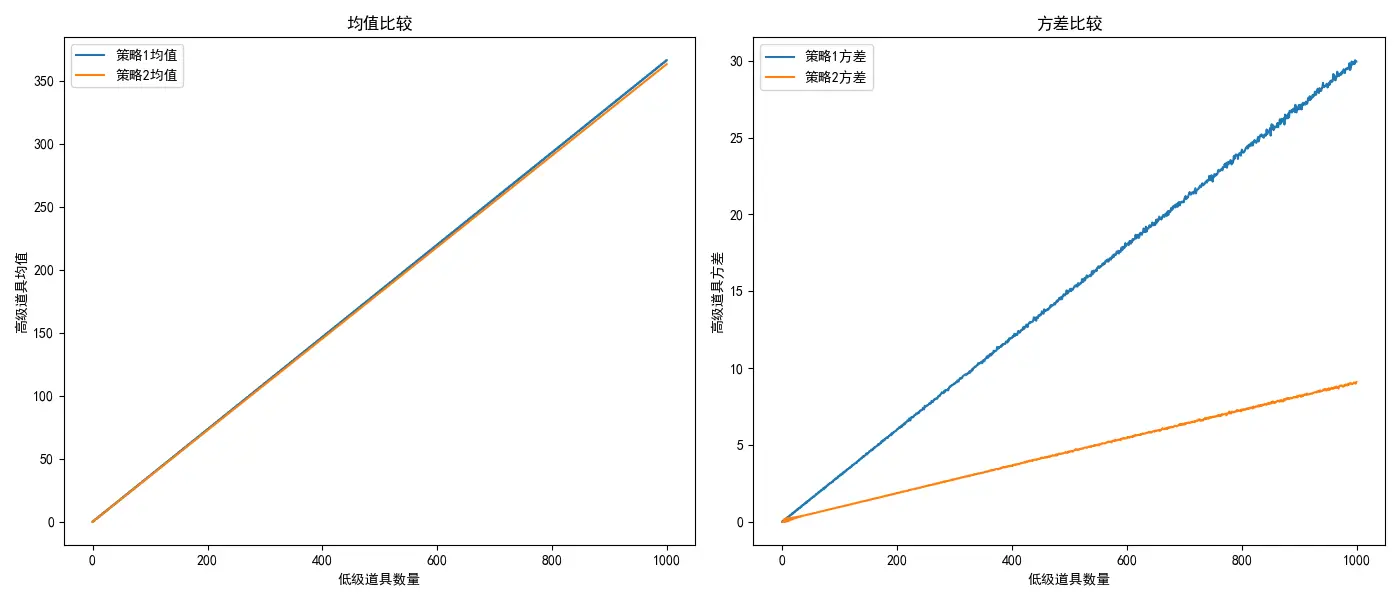
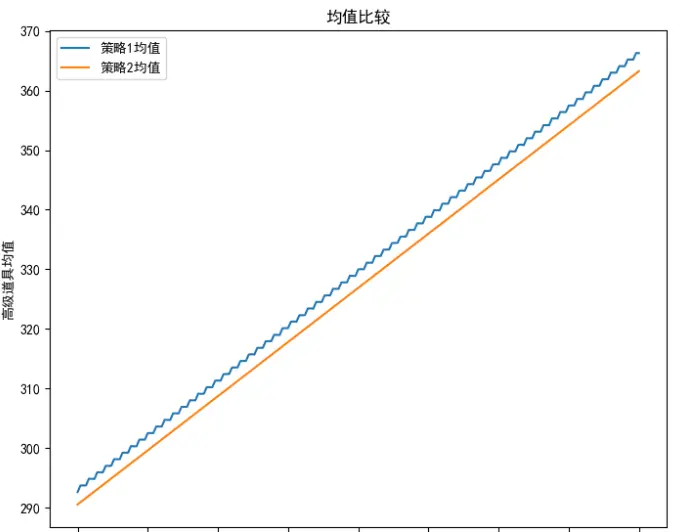
Fitting with code, it also matches the computed result:
- The 10% has a slightly higher expectation, but within 1000 materials the difference in expectation isn’t large.
- The 25% has smaller variance fluctuation; it just needs more crafts, so the Mora cost is a bit higher.
- Considering Genshin Impact’s 999 material cap, the expected high-level materials differ by only about 2-3.

Experiment code
| |
For more discussion, see: Genshin Impact Probability