
The Power of Ideas: When Judges Learn Economics

Education is what remains after one has forgotten everything learned in school. - Albert Einstein
Preface
Picture this: an economics student comes home for the Lunar New Year and is still talking about neoclassical models, Bellman equations, and the Lucas critique, while no one at the dinner table understands a word. When relatives ask what he has gained from all those years of study, all he can say is that he has proved a general equilibrium, run some time-series analysis, and solved a dynamic optimization problem.
While everyone else is stuffing red envelopes into their pockets, he may still be thinking about how to resolve endogeneity in a paper. In moments like that, we cannot help but ask: what does studying economics really change in a person? After the technical jargon fades from memory, what actually remains from an education in economics?
This post discusses Ideas Have Consequences: The Impact of Law and Economics on American Justice, published in the QJE in 2025. The author’s website also contains a wealth of useful materials.
The paper studies how judges changed their decision-making after participating in economics training. It finds that judges who attended the program used more economic language in their written opinions, opposed regulatory agencies more frequently, and imposed harsher criminal sentences. The paper not only examines the real-world consequences of the intersection between law and economics, but also provides evidence for the persuasive power of economic ideas.
Background
The Law and Economics Movement
Beginning in the 1970s, the Chicago School became the center of the law-and-economics movement. Over the following decades, the application of economic ideas in legal thought moved from the margins to the mainstream. By the 1980s, economic reasoning had spread into nearly every field of law.
Under the influence of the Chicago School, conservative scholars in law and economics often criticized regulation by emphasizing its unintended negative economic consequences and the risk of regulatory capture. Conservative scholars and judges became deeply involved in debates over labor law and environmental regulation. Economic deterrence theory also left a strong imprint on criminal law.
The Manne Economics Institute for Federal Judges
Part of economics’ influence on legal thought can be traced to a training program for sitting judges: the Economics Institute for Federal Judges. The program ran from 1976 to 1998 and was offered once or twice a year. From the beginning, all federal judges were invited, beach-hotel expenses were covered, and places were allocated on a first-come, first-served basis. This means the program was not designed around a narrow preference for specific types of judges.
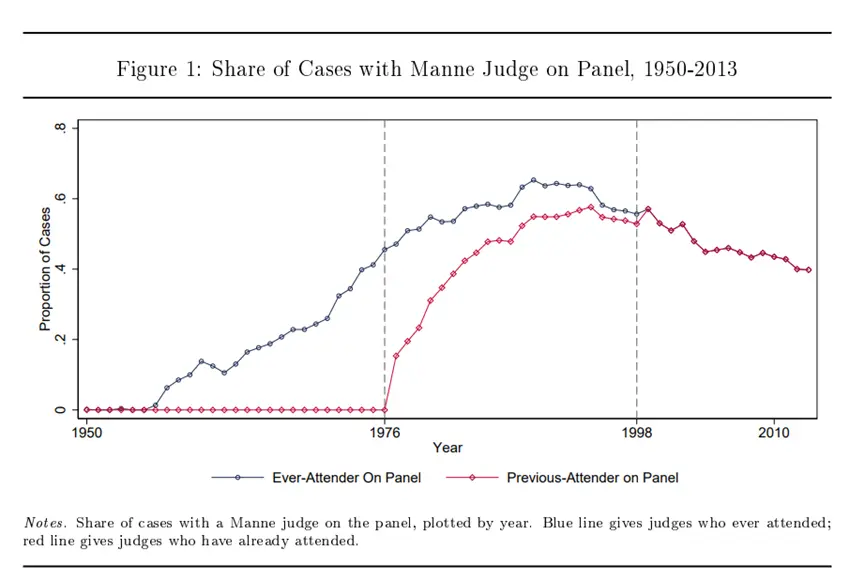
The Expected Impact of the Training Program
Formalist theories of law hold that judges strictly apply written law without regard to non-legal factors. Attitudinal theories emphasize party affiliation and suggest that partisan replacement should wash out any effect of the Manne program. In reality, however, judges exercise substantial discretion, and a large literature shows that non-legal factors do affect judicial decisions. The variation in exposure generated by the Manne program allows us to test whether rigorous economic ideas can genuinely persuade judges and, if so, what legal consequences follow.
Data
Case Data
The U.S. federal court system has three levels: district courts, circuit courts, and the Supreme Court. The paper collects appellate decisions from U.S. circuit courts between 1970 and 2005 from Bloomberg Law, and cross-checks them against the Singer database, the Federal Judicial Center dataset, and LexisNexis. The data include judge characteristics such as gender, religion, family background, degrees, and work experience. In the case sample, 20% of cases involve regulation and 5% involve labor issues.
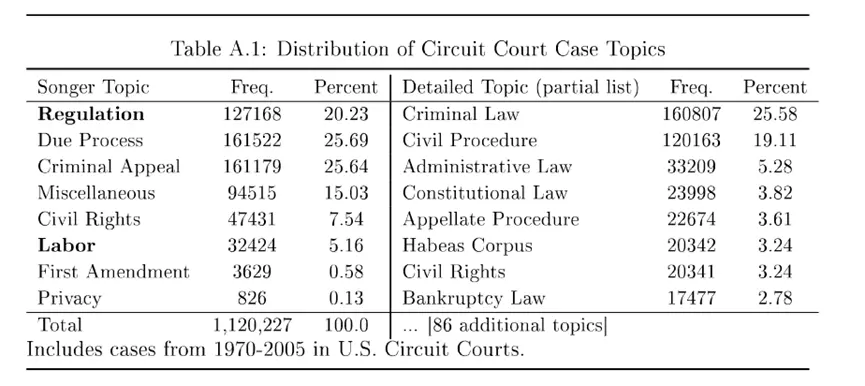
Judicial Writing Style
The paper uses a word-embedding approach to identify the economic style of judicial opinions. The authors first remove capitalization and punctuation from written opinions and preprocess the text into token lists. These lists are then linked to a legal-economic vocabulary database. Because only a small share of cases contain explicit economic terms, simple word-frequency measures are not very informative, so the paper instead relies on contextual similarity.
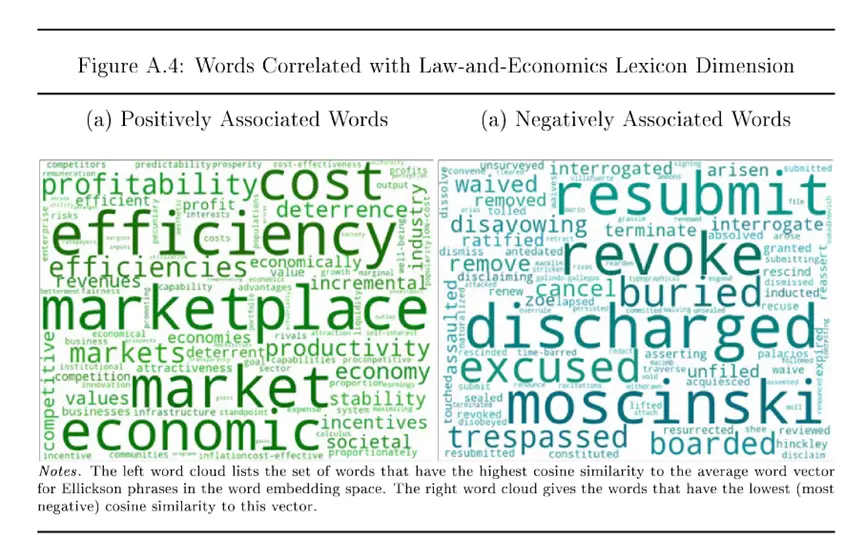
Judicial Outcomes
The paper focuses on three categories of outcomes:
Labor and environmental regulation: whether judges vote against government agencies or labor authorities. A vote against the regulator is interpreted as a more deregulatory stance.
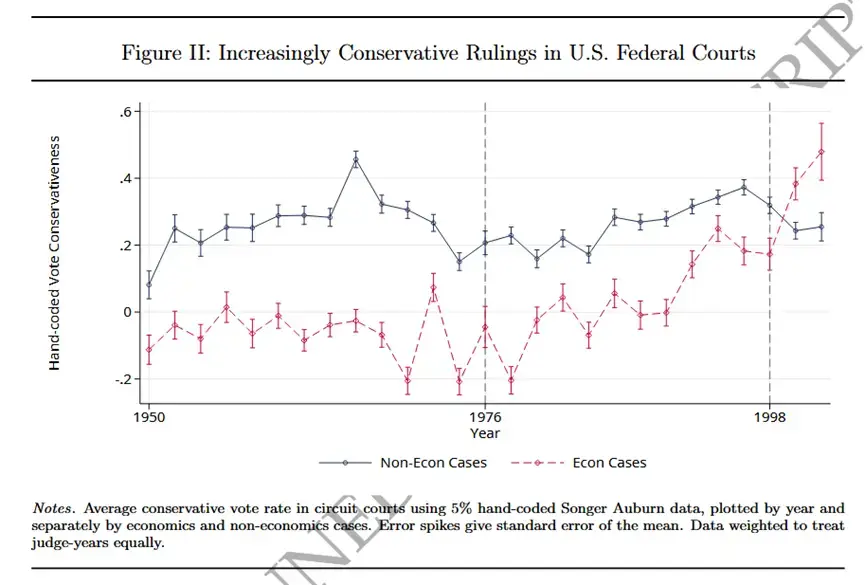
Conservative judging: based on the legal claims in a manually coded subset of cases (5% of the sample), decisions are classified as liberal, conservative, neutral, or hard to code. The figure shows an upward trend in conservatism.
Criminal sentencing: including crime type and sentence severity, with the main outcome coded as a binary indicator for imprisonment.
Empirical Strategy
Estimation Strategy
$$ Y_{ijct}=\alpha_{j}+\alpha_{ct}+\gamma Z_{jt}^{\mathrm{post}}+X_{ijct}^{\prime}\beta+\epsilon_{ijct} $$ $$ Y_{ijct}=\alpha_{j}+\alpha_{ct}+\sum_{k\in V}\gamma_{k}Z_{jt}^{k}+X_{ijct}^{\prime}\beta+\epsilon_{ijct} $$
- Case $i$, judge $j$, court $c$, year $t$. The paper includes judge fixed effects and court-year fixed effects.
- Dependent variable $Y$: decisions, votes, or the economic style of written opinions.
- Independent variable $Z$: an indicator for whether the judge has entered the Manne program.
Tests of the Identification Assumptions
Random Assignment of Cases
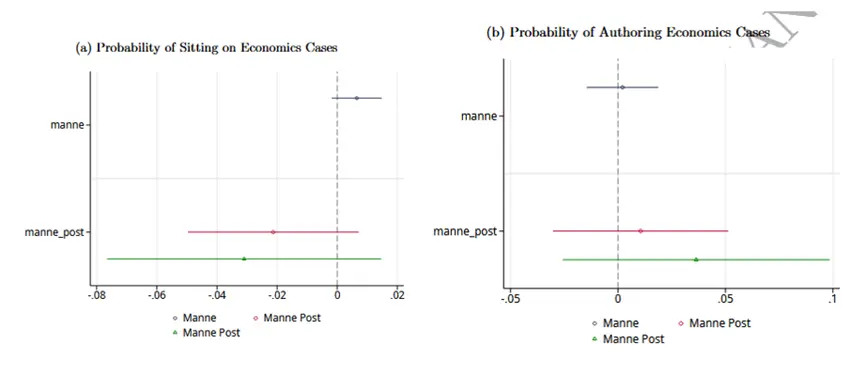
Because training slots were allocated on a first-come, first-served basis, the paper adopts a staggered DID design. This requires additional checks: are cases randomly assigned across judges, and do early participants differ systematically from later participants? In the U.S. court system, cases are randomly assigned by computer, and repeated judicial panels are intentionally avoided. The figure below shows no statistically significant difference between Manne participants and non-participants in the types of economic cases assigned to district and circuit judges.
The Assumption Behind Training-Cohort Assignment
The paper examines the characteristics of judges across Manne training cohorts. Judges appointed by Republican presidents were more likely to participate in the Manne program and to appear in earlier cohorts, but Republican appointment was not related to the precise timing of participation.
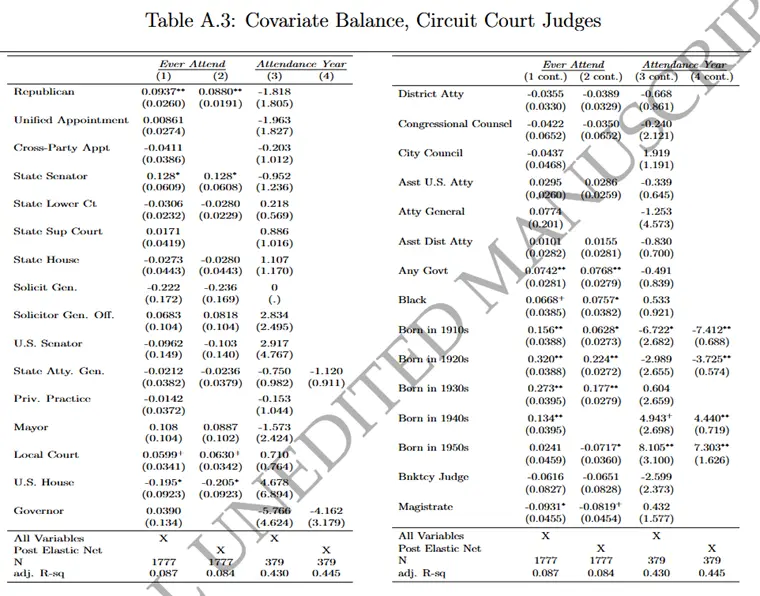
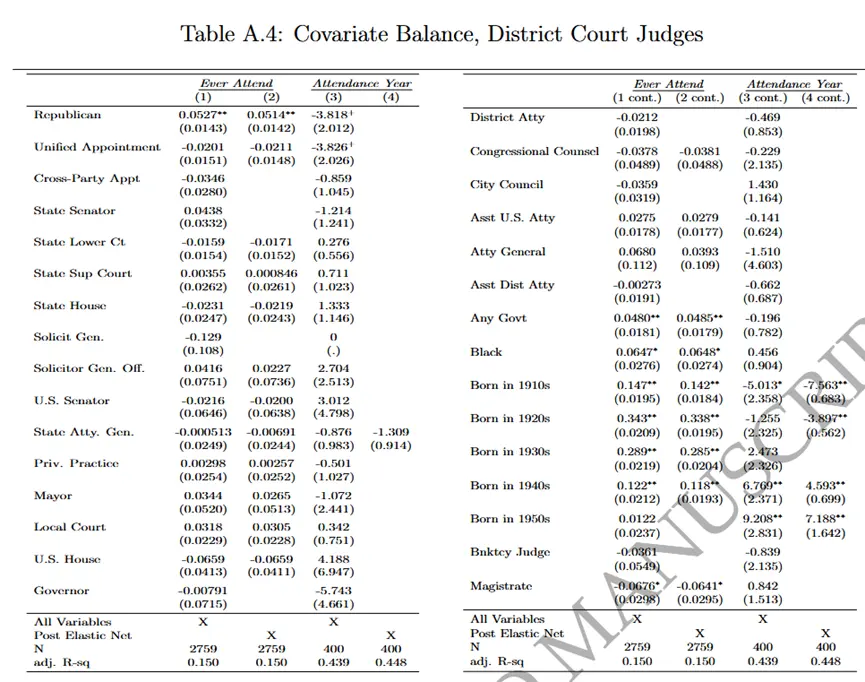
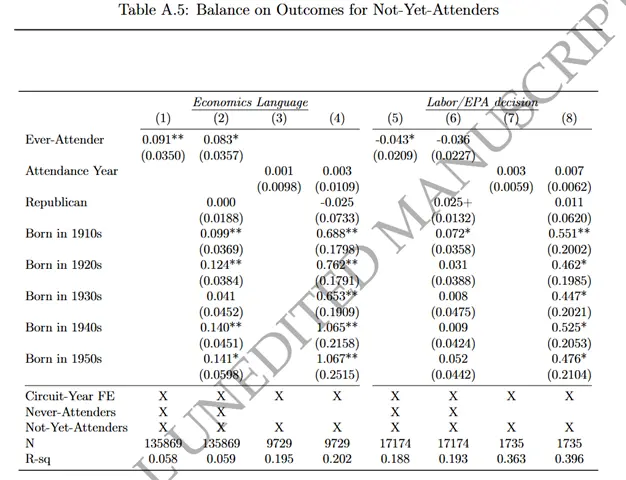
The paper further compares judges within the same court and the same year, contrasting participants and non-participants, and finds that differences are not significant. To address any remaining selection concerns, the authors predict each judge’s participation year using all available controls and include that prediction in the analysis.
No Spillover Effects (SUTVA)
Strictly speaking, DID already assumes no spillovers. Yet many papers still end by testing for spillovers, even when they are not using spatial econometrics.
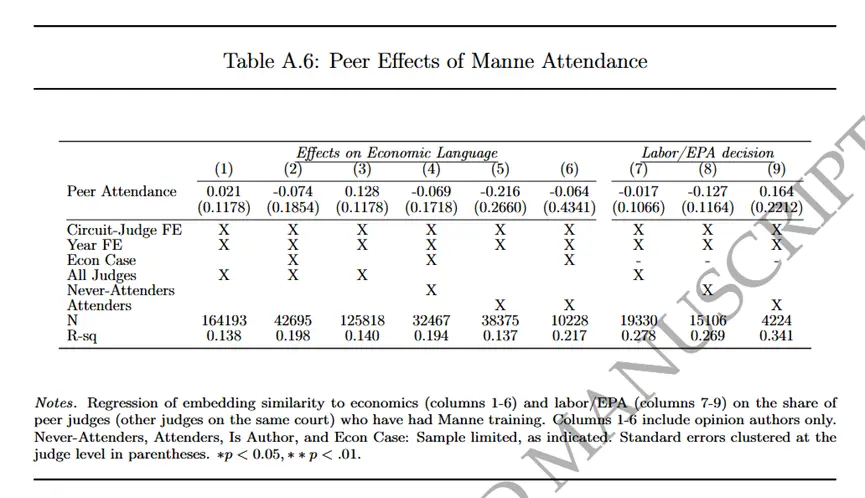
To preserve the validity of staggered DID identification, the paper tests for spillovers from trained judges to their colleagues. Judges are generally thought to work relatively independently, and communication is limited when cases are randomly assigned. The authors also control for the share of colleagues in the same court who attended the training. Additional tests show that spillovers are weak.
Empirical Results
Judicial Language Style
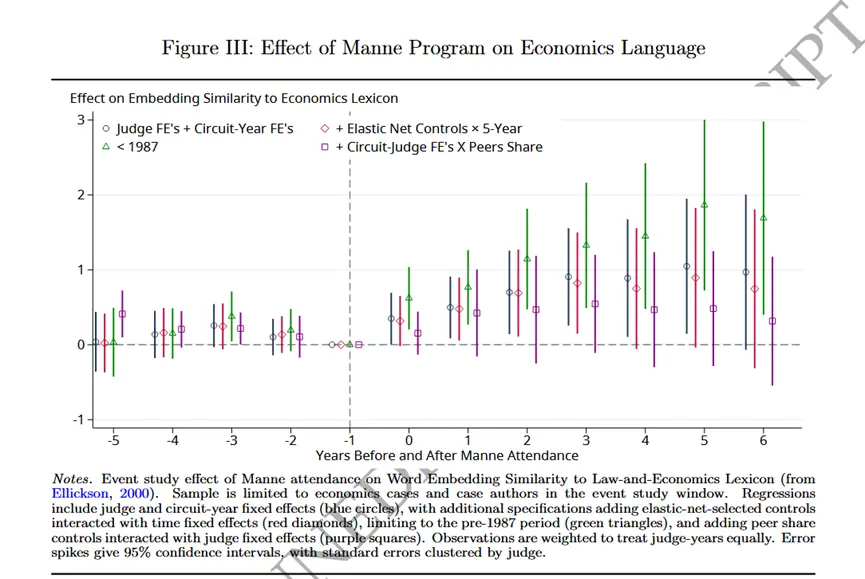
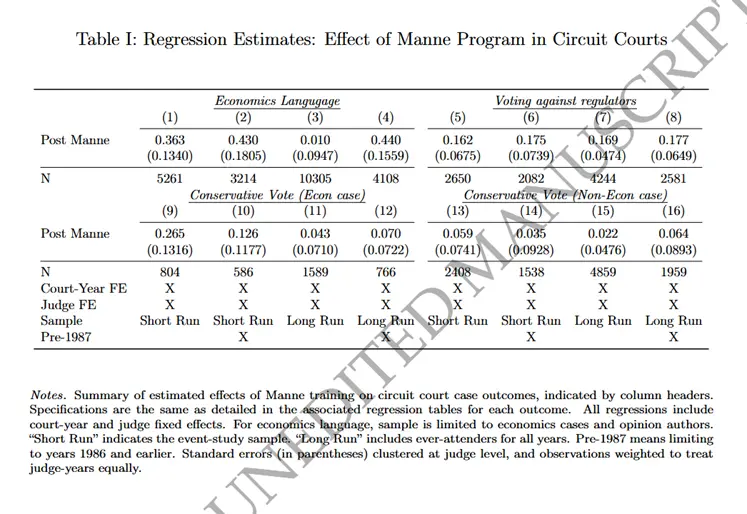
The results show that judges who attended the Manne program became more likely to use economics-related language in their written opinions. As a placebo exercise, the paper replaces the economics-language measure with a law-language similarity measure, and the effect is not significant.
Attitudes Toward Regulation
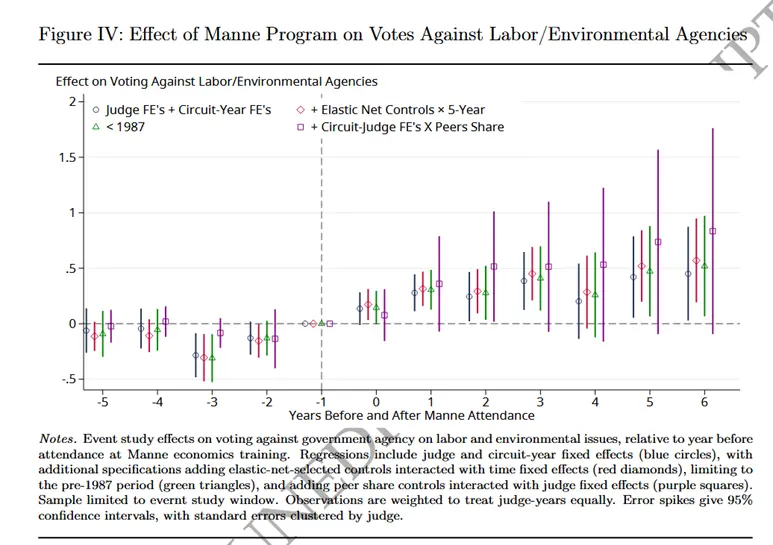
The paper mainly examines judicial votes in cases involving labor and environmental regulation. The results show that after the training, judges became more likely to oppose regulators. The authors also test a sample of antitrust cases. The estimate is positive but not statistically significant, possibly because the sample is relatively small.
Effects on Sentencing
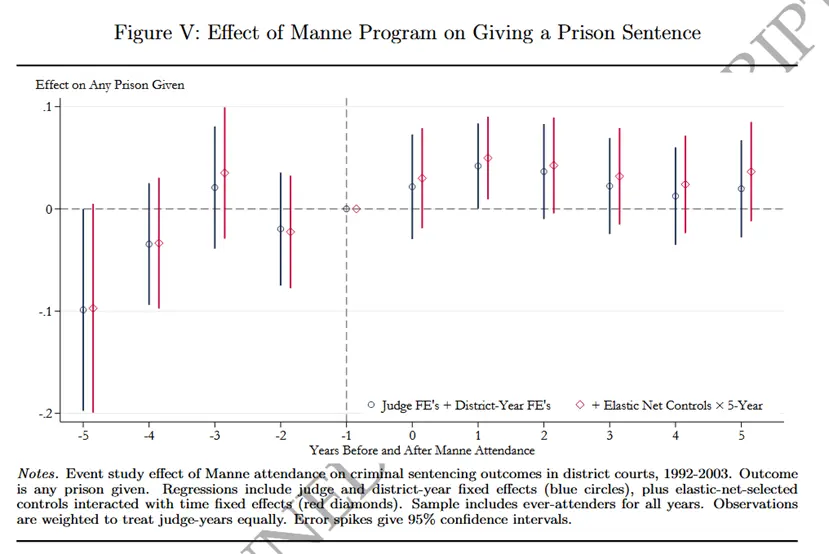
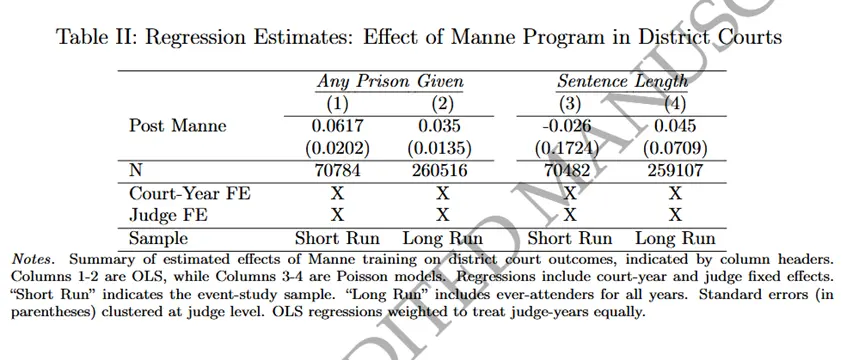
The direction of economics’ effect on sentence severity is not obvious in theory. But if one thinks in terms of deterrence and the reduction of crime-related economic losses, then a framework that raises the cost of crime might lead judges to impose harsher punishment. The results suggest that trained judges become more likely to sentence defendants to prison.
Extended Analysis
The paper also reports short-run effects for circuit courts.
Using a Poisson model for incarceration, the paper finds that training raises imprisonment by 6.2% in the short run and 3.5% in the long run. Sentence length itself does not change significantly, perhaps because judges have less discretion over duration than over the incarceration decision.
The paper then proposes a persuasion model:
$$ p=100\times\frac{\Delta y}{\Delta e}\cdot\frac{1}{(1-y_0)}. $$
- $y_0$ is the share of judges who had participated in economics training, which is 46% in the descriptive statistics.
- $\Delta y$ is the change in the share of persuaded judges, measured here as the increase in anti-regulatory voting. Using a conservative estimate from the robustness checks, this is 4.3%.
- $\Delta e$ is the share of the population potentially exposed to persuasion. Under the assumption that all judges could in principle be affected, this equals 1.
Plugging these numbers into the formula yields an estimated persuasion effect of about 8% from economics training. Comparable estimates in other settings include the effect of Fox News on Republican voting (11.6%) and the persuasive effect of a 10-week subscription to The Washington Post on Democratic vote share (19.5%). Even so, the paper’s 8% is probably conservative, because it only studies trained judges. The course materials were also read by students, lawyers, and other related groups, and many of the opinions written by trained judges using economic analysis may themselves become precedents that spread those ideas further.
Robustness Checks
Pre-trend tests are reported.
The authors alter the sample window by restricting attention to judges observed within three years before and after training in a balanced panel, and by expanding post-training years to estimate long-run effects over the full judicial career.
They also alter the variable definitions by replacing the word-embedding measure with a machine-learning-based similarity measure for economic language.
Additional controls include the appointing president, the predicted participation year, the interaction between a judge’s own participation and the share of colleagues who participated, and case-type fixed effects. Standard errors are reported in robust form as well as with two-way clustering by court and year.
Finally, the sample is reweighted so that court-year cells with more cases receive greater weight.
Conclusion
Economics is a general decision-making framework, and judges must make high-stakes decisions across many policy domains. What economics teaches is not just a set of technical tools, but a way of thinking about decisions. After training in economic reasoning, judges may become more skeptical and perhaps better able to recognize biased materials than before, even if they are not economists themselves.
The paper is impressively careful in its identification strategy. Its tests of no spillovers and random assignment are especially worth learning from. Across the three categories of outcomes, the authors also choose closely related placebo variables, which makes the overall argument more persuasive. Although the paper uses word embeddings to measure economics-related language, there is still room to think more deeply about how ideas themselves should be measured. The paper openly notes, for instance, that the theoretical direction of economics’ effect on sentencing is complex, and it does not fully explain the distinctive mechanism of the economic framework. There is still much to explore: How do economic ideas diffuse? How does language style differ across economics journals? Can judicial harshness be measured through word choice in written opinions? These all seem like promising research questions.
Statistical evidence from economics can never substitute for legal evidence, but the habits of thought developed in economics can make the presentation of legal evidence more persuasive. That is why the Manne program chose a dialogue between law and economics rather than some other interdisciplinary pairing. As Deirdre N. McCloskey argues in The Rhetoric of Economics, economics may ultimately be a discipline that teaches people how to persuade. And that framework of persuasion may be the most precious legacy economics leaves behind, as well as the quiet contribution embedded in so many papers.