
The Mountain Pass Is Hard to Cross: A Brief Analysis of Sichuan's Teacher Title Evaluation Documents

The mountain passes are hard to cross. Not only because of the passes themselves, but because the rules at their foot have never been in the hands of those who travel the road.
Recently I came across some of the real-world problems around primary and secondary school teachers applying for the title of Senior Teacher. I suddenly found that the history of the relevant policy documents is rather interesting and says something about how bureaucratic governance works in China. Hence this record.
The Road to Professional Title Promotion
Posts and Professional Titles
Posts and professional titles are not the same thing. A post is the position a teacher occupies (logistics, administration, teaching, and so on), while a professional title reflects the teacher’s level of professional and technical competence.
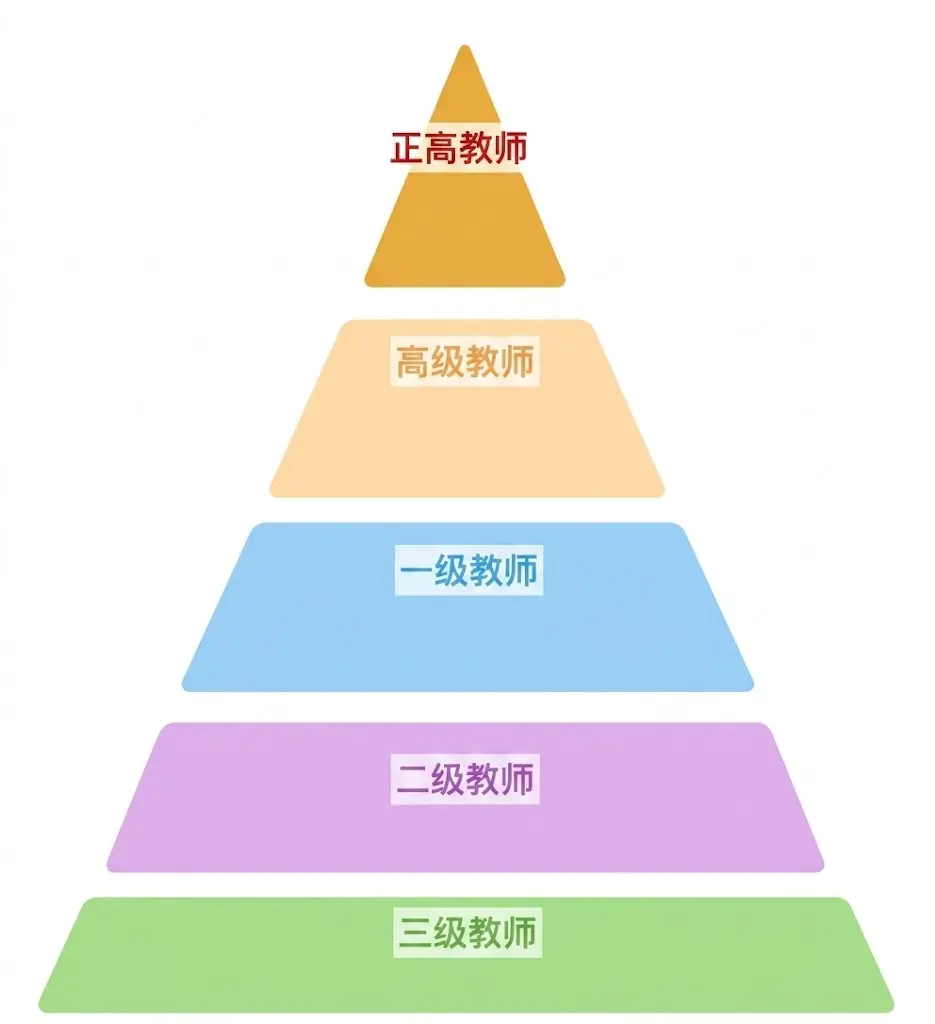
In China’s compulsory-education stage, meaning primary and junior secondary schools, teachers’ professional titles run, from lowest to highest, through the five grades of Third-Grade Teacher, Second-Grade Teacher, First-Grade Teacher, Senior Teacher, and Professor-Grade Senior Teacher.
For most teachers, the title mainly affects their salary. Pensions are tied to years of service too: the earlier you obtain a title, the higher your retirement salary, because it grows with the number of years you taught while holding that title1.
The two harder hurdles are the moves to First-Grade Teacher and to Senior (Associate) Teacher. For Second-Grade Teacher, the required years of service are usually enough to establish seniority. First-Grade Teacher, by contrast, carries award requirements such as teaching-reform competitions and Outstanding Teacher awards, and you have to go through a selection process.
National-Level Policy Documents
Before 2015, the documents governing primary and secondary school title evaluation were the Notice on the Three Guiding Opinions on Post Establishment and Management in Educational Institutions (Guo Ren Bu Fa [2007] No. 59), which in turn inherited from the earlier management document Provisional Regulations on the Professional Positions of Secondary School Teachers (Zhi Gai Zi [1986] No. 112).
The key points are as follows:
- The posts and titles of primary schools and junior secondary schools were kept separate. Secondary schools had Secondary Senior and First- to Third-Grade titles; primary schools had Primary Senior and First- to Third-Grade titles.
- Titles depended on posts. In most cases a teacher’s professional title matched a work post. Primary Senior Teacher, for example, was both a post and a title.
- Post levels were subject to proportional-control requirements.
Document Guo Ren Bu Fa [2007] No. 59:
- The establishment of posts in institutions of higher education is subject to controls on total number of posts, structural proportions, and the highest grade.
- Management posts in compulsory-education schools generally have 6 staff grades. The highest grade of management posts, their structural proportions, and the number of staff at each management grade are determined according to the school’s scale, size, and administrative affiliation, in accordance with the relevant regulations and authority on cadre and personnel management.
In other words, the quota of professional titles was basically tied to posts, and the grade proportions of posts were adjusted according to the scale of the workforce. Take region A as an example. With 100 teachers in 2000, the government might hand out 10% of the Senior Teacher post quotas (10 slots) and 20% of the First-Grade Teacher quotas. By 2010 there were 200 teachers, and the quotas rose in proportion, so 10% came to mean 20 Senior Teacher posts. Over those ten years, as the teaching force grew, ten extra Senior Teacher posts were created.
Professor-Grade Senior Teacher is controlled in total at the national level, so the proportional control on Senior (Associate) Teacher is, for ordinary teachers, the ceiling of the professional-title ladder.
A First-Grade Teacher is at the intermediate level; a Senior Teacher is at the associate-senior level. Above that, the quotas for Professor-Grade Senior Teacher are extremely scarce, so for most teachers the ceiling they can reach in a lifetime is really just Senior Teacher. The “mountain pass” that hundreds of thousands of teachers across Sichuan are squeezed through is, in the end, that single leap from First-Grade to Senior Teacher.
After 2015, the guiding document became the Guiding Opinions on Deepening the Reform of the Professional Title System for Primary and Secondary School Teachers (Ren She Bu Fa [2015] No. 79). The main changes:
- The title systems of primary and secondary schools were merged, effectively unifying allocation within the compulsory-education stage.
- Title evaluation conditions were required to keep pace with the times.
- Appropriate preferential treatment was given to rural schools.
Around 2015:
- The title quotas of primary and secondary schools were merged, which enlarged the power of principals in integrated primary-junior secondary schools2.
- Title requirements kept pace with the times, marking the start of teachers competing in teaching-reform competitions, lesson-plan competitions, micro-lecture competitions, and paper publication.
- If the size of the teaching establishment did not change, the quota of title posts stayed basically unchanged.
Personnel Authority
The allocation of authority over title evaluation is a textbook bureaucratic structure: the center sets the framework, the province sets the floor, the city adds more, and the county implements.
- The state uniformly sets the overall direction. It decides broad matters such as reasonable proportions, evaluation standards that fit the era, and appropriate support for rural areas. The remaining implementation details are left to local discretion, so localities can tailor their indicators to local conditions.
- Provinces issue more specific implementation rules.
- Prefecture-level or county-level cities dominate personnel-appointment authority and the concrete selection standards and plans. That is, title quotas are basically coordinated and arranged at the tier of the prefecture- or county-level city.
Local Policy: The Case of Sichuan
Escalation and Lag in Local Policy
Here Sichuan is used as an example.
- The center sets the overall route while localities formulate the detailed rules. This is an allocation problem of discretionary power. Localities know local information better and can make better decisions, but the arrangement also carries risks of local protectionism and corruption.
- In practice, localities also need time to respond, so implementation lags behind signals from the center.
- Bureaucratic governance carries a risk of layer-by-layer escalation: local selection standards rise above the central baseline and produce involutionary competition.
- Seen through a principal-agent lens, localities do have easier access to the information needed for implementation. But if local agents have no incentive to gather and understand that information, the institution never achieves its intended effect. This is the dilemma at the heart of contemporary institutional design. If title evaluation is tied to the interests of the policymakers, they will seek private gain. If it is not, and only people who have already obtained titles are allowed to make policy, they tend toward bureaucratic indolence.
After the central reform, Sichuan’s formal documents were noticeably slow to follow. The relatively complete formal document is roughly the Basic Conditions for the Declaration and Evaluation of Professional Titles for Primary and Secondary School Teachers in Sichuan Province (Chuan Jiao [2020] No. 85).
It piles on, layer by layer, extra requirements on annual assessment, academic credentials, years of teaching, and so on.
Most importantly, it adds a teaching-support (zhi jiao) requirement:
(1) Teachers in urban (including county-town) primary and secondary schools who apply for a position at or above First-Grade Teacher must have 1 year or more of teaching-support (or teaching) experience since taking the current post, or 2 years or more since beginning teaching, at a weak school, a rural school, or a school in one of the “four major regions.”
(2) For those who teach weak schools, rural schools, or schools in the “four major regions” online, or provide high-quality resources free of charge, the relevant education administrative department at or above the county level shall determine the equivalent class hours by considering usage, online click-through rates, and so on. The time converted according to the local standard workload for teachers shall be regarded as corresponding teaching-support (teaching) experience. Teaching by teachers at “Sichuan Cloud Education” anchor schools, and the teaching (teaching-in-post) time of college students participating in Liangshan in-post teaching support, shall be regarded as teaching-support (teaching) experience.
But note that this requirement targets urban teachers seeking title promotion. Urban teachers must complete teaching support before they can be promoted.
The corresponding requirement for rural teachers was not filled in until 2024 (Chuan Ren She Ban Fa [2024] No. 56). More striking still, such an important document cannot be found on Sichuan’s government websites. We can only learn its requirements through “Ask Sichuan Government” (Wenzheng Sichuan) and secondary citations by local governments.

The most important part is the requirement of urban-rural job rotation:
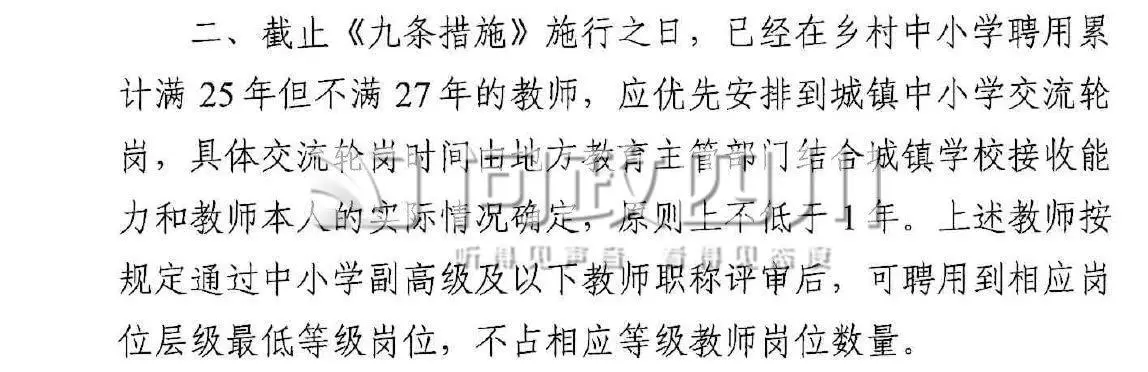
Taking the Nine Measures (Chuan Ren She Fa [2023] No. 95) as the time node, that is January 1, 2024, the rules for rural teachers are:
- Those employed for fewer than 25 years take part normally in the competition for title quotas.
- Teachers with 25-27 years of service must complete one year or more of job rotation.
- Teachers with 27 years of service or more are exempt from the rotation requirement.
So teachers who satisfy conditions 2 and 3 do not occupy normal quotas; this is effectively a green channel. But teachers satisfying conditions 2-3 are, by then, close to retirement.
The third category, which needs no rotation, is the most favorable to rural teachers and amounts to a near-direct path to Senior Teacher. The crux is the second category: for those genuinely stuck at the rural-teacher promotion bottleneck, the real question becomes how to successfully rotate into an urban post.
From the 2015 emphasis on rural preferential treatment to the actual promulgation in 2024, Sichuan took a full 9 years. And the bigger problem is how the rural-to-urban rotation system is meant to be implemented. As far as this author knows, it was only gradually rolled out at the county-level city tier by 2026, another two-year lag.

Examples from Ask Sichuan Government
The Ask Sichuan Government platform is a good channel for public supervision and assistance! 👍
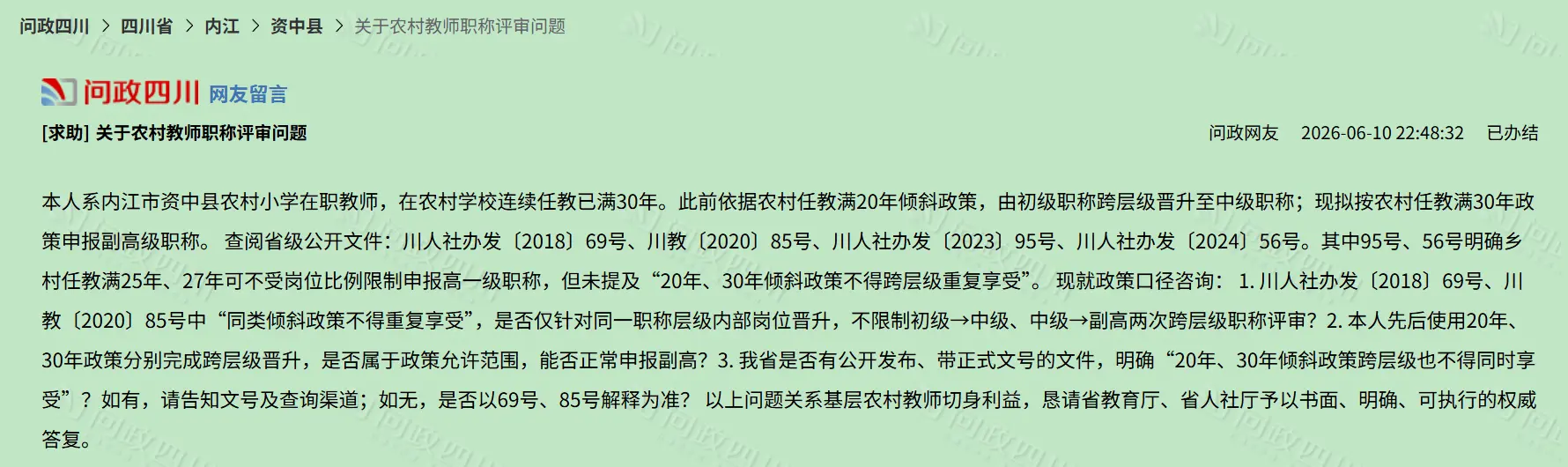
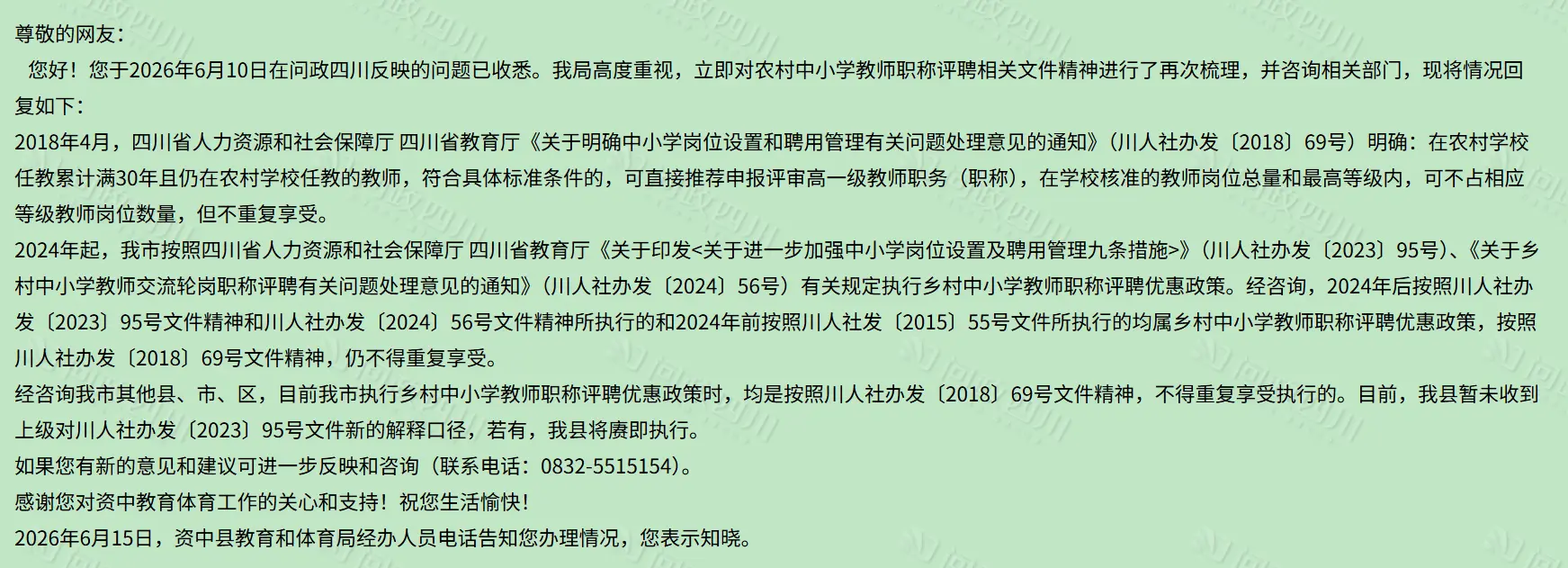
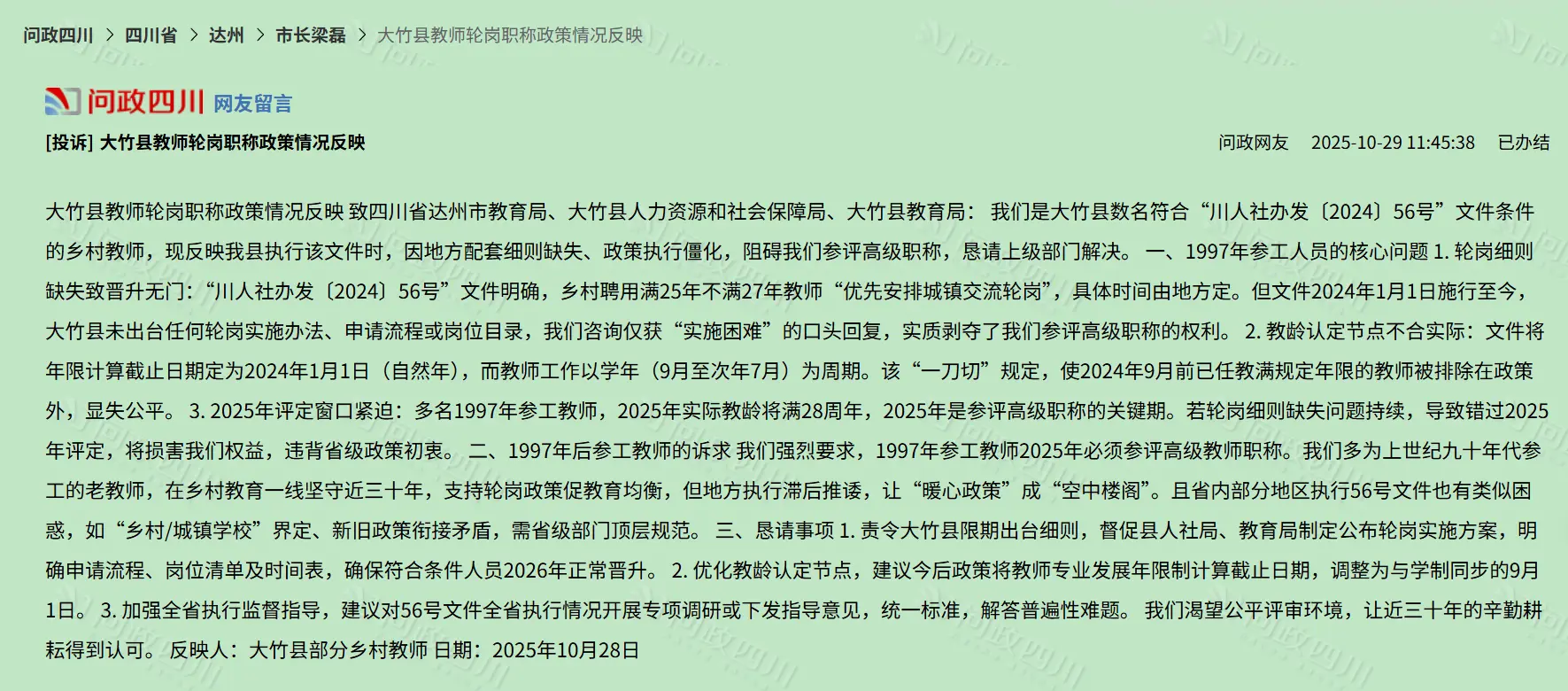

- Suining City, Anju District: The Deteriorating Educational Ecology
- Guanghan City: On the Issue of Rural Teachers Rotating into Urban Posts
- Chengdu Gaoxin Yunxin School’s Opaque Title Evaluation and Performance Pay
- Serious Procedural Violations in the Senior (Associate) Title Evaluation for Teachers in Nanchong City
- Longquanyi District’s Quota Restrictions on 2024 First-Grade Title Evaluation
Some Reflections
First, the black and red of bureaucratic governance.
Understanding Chinese policy means understanding central-local relations. In the most ideal conception, the center coordinates the whole and sets up a division of labor and cooperation; otherwise each locality goes its own way, and fragmentation is not a good outcome either. Bureaucratic governance is therefore fundamentally a problem of dividing residual discretionary power.
The key is how to design incentives. Yet the choice of implementers itself faces a dilemma. If title evaluation is tied to the interests of the policymakers, they will seek private gain. If it is not, and only people who have already obtained titles are allowed to make policy, they tend toward bureaucratic indolence. This is especially true for indicators like human capital that are hard to quantify meaningfully.
Official tournament competition and bureaucratic governance can sometimes edge toward a law of the jungle, and both end up accountable upward. On university campuses I often hear teachers complain about academic assessment: laymen directing experts, unreasonable standards. But the moment students feel the postgraduate-recommendation rules are unreasonable, almost every teacher seems to wave off student grievances as pure utilitarianism and wish to keep their distance. Is that not also a form of accountability upward?
Why does the law of the jungle so often become the social norm? The opposite of accountability upward is fragmentation and internal attrition downward. Once that sets in, it is hard to build united resistance.
Second, economic problems and management problems.
The old joke only gets more classic: the intentions above are good, the implementation below goes wrong.
Economic problems are not merely economic. The top-level ideas are all positive: scientific assessment, preferential treatment for rural areas. But implementation suffers from internal response lags and missing incentives. Since personnel authority sits with the lower-level cities, it is hardly surprising that every locality first arranges how urban teachers are promoted and assessed, and only later considers rural teachers.
The waste of time in implementation can also create crises. The policy was meant to benefit rural areas, dividing teachers into three batches by years of service. Yet by the time the favorable policy came out, many teachers had long since retired.
Third, openness and transparency.
The most concentrated complaints about title evaluation on Ask Sichuan Government are about “non-disclosure”: quotas not published, reserved quotas, differential review results announced only by word of mouth, scoring rules that cannot be explained, and shortlists in which frontline teachers appear once while leaders take up most of the slots. The more complex and opaque the rules, the more the power of interpretation concentrates at the top. Undisclosed rules become bargaining chips in the hands of those above. The unquantifiable “local conditions” added by layer upon layer of escalation are precisely the most convenient places for “manipulation.”