
The Monetary Framework of Spatial Political Economy: A Summary and Critical Review

Professor Lu Ming has developed a spatial political economy framework for understanding China’s economic development. Since the policy push for a “unified national market,” the framework has found a more concrete anchor.
To my mind, the phrase that captures Lu Ming’s spatial political economy better than any other is — balancing through agglomeration. The research program centers on interventions and distortions in the processes of population mobility, urban growth, and factor concentration.
But what is “development”? What is “balance”? These are the kinds of questions that, like “what is justice?” or “what is morality?”, generate endless debate.
After watching several of Lu Ming’s lectures and reading his books, I found a number of his ideas1 worth writing down. What follows is a summary with my own commentary.
The Monetary Theory of Spatial Political Economy
International economics gives us the “impossible trinity” — the idea that a country cannot simultaneously maintain monetary policy independence, exchange rate stability, and free capital mobility.
Though this looks like a macro-level framework for trade between nations in an open economy, it applies just as well within a single country — giving micro-level research a macro foundation2 😜.
Think of it this way: each province is, in effect, a small country. Inter-provincial protectionism functions like trade barriers between nations. But here’s the difference. Unlike sovereign states, provinces cannot run independent monetary policies. The situation is closer to the Eurozone.
Monetary unification requires one of two conditions3:
- Similar industrial structures across regions, so a single monetary policy suits everyone.
- Free population mobility, so factor flows endogenously offset the differential impact of a uniform policy across regions.
China, however, is a unified country with a single currency, diverse regional industrial structures, and a hukou system that restricts population mobility. The combination creates serious problems.
The question that follows: under these constraints, how do you promote development in lagging regions?
The Development Theory of Spatial Political Economy
Three Modes of Competition
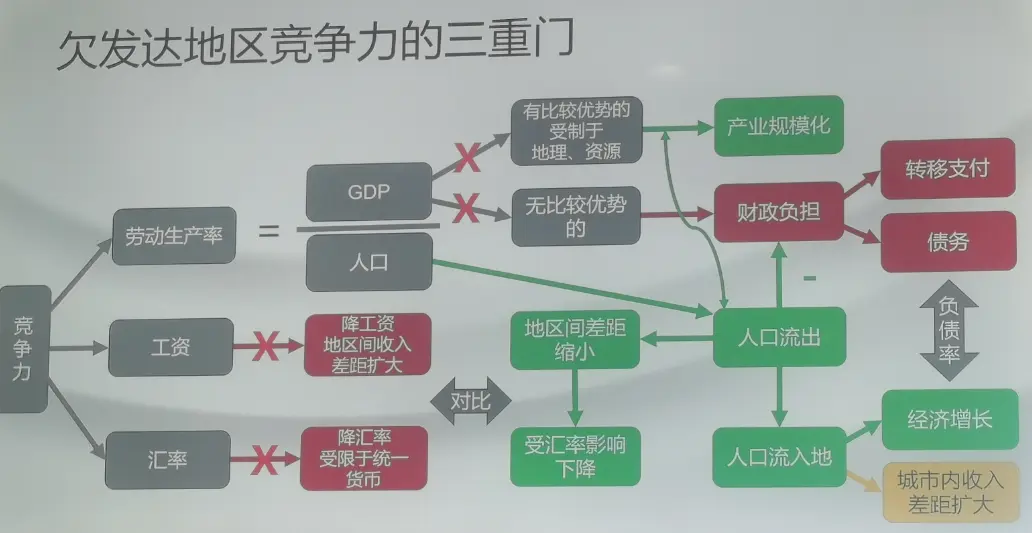
Lu Ming argues that competitiveness boils down to three channels:
- Wages: Lagging regions can compete on cheap factor prices, but this widens regional wage gaps and works against common prosperity.
- Exchange rates: With a unified monetary policy, this path is closed.
- Labor productivity: This route encompasses both GDP and population.
Approaching Development through GDP
Start with GDP — which largely reflects local fiscal capacity and industrial capacity. Regions with comparative advantages find those advantages constrained by geography and natural endowments4. Regions without them need central government support through fiscal channels: local debt and transfer payments.
Example 1: The structure and impact of public finance
Many people treat local government debt as productive investment. But China’s local debt ratio has been rising steadily. Treat debt as (x) and local output as (f(x)) — the proposition loses money. Calling local debt “productive investment” doesn’t hold up.
Example 2: The structure and impact of public finance
Why are provinces like Shandong notorious for their civil service exam culture? There may be an economic explanation beyond the cultural one. Shandong lacks strong comparative advantages, and its private sector is underdeveloped. The result: heavy reliance on public-sector hiring to absorb employment. With a weak local private sector, fiscal capacity depends on central transfers. This gives us a unified framework for understanding why lagging regions simultaneously suffer from weak growth momentum, dependence on transfer payments, and ballooning government debt5.
Approaching Development through People
The idea is to relax restrictions on population mobility, letting migration offset the uneven regional effects of a single monetary policy.
For population-sending regions, per capita GDP rises. The gaps between regions narrow. In The Centripetal City, Lu Ming uses data from the Shenzhen metropolitan area to show that stronger inter-city mobility shrinks regional disparities6.
Example 3: Individual welfare and local welfare
Lu Ming tells of an entrepreneur in one of his classes who said that, after the course, he understood that his greatest contribution to his hometown was leaving it. Capable people develop their potential more fully in places better suited to them, without crowding out local resources — leaving jobs for those who stay, and so on. Per capita welfare at the local level improves.
For population-receiving regions, labor is deployed more efficiently, driving growth. The main cost is widening income inequality within cities. But weighed against widening regional gaps and mounting local debt, this trade-off looks favorable.
Commentary
Economic Phenomena vs. Physical Phenomena
A fascinating finding in urban economics is that city sizes in developed countries tend to follow Zipf’s law.
City rank and population are inversely related: the second-largest city is about half the size of the largest, the third-largest about a third, and so on.
The figure below shows Zipf distribution fits for Japan and China, from The Centripetal City. Japan’s city size distribution (left panel) tracks Zipf’s law closely; China’s (right panel) deviates considerably. The implication: China’s big cities aren’t big enough, and its small cities aren’t small enough.
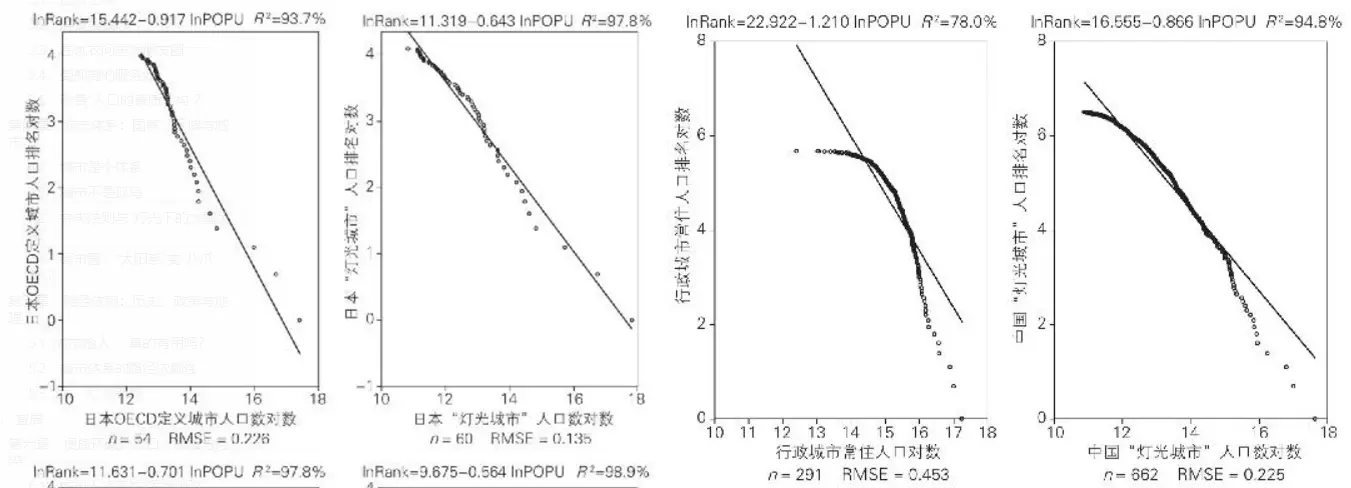
Zipf’s law was first discovered in linguistics: word frequencies in a book follow a Zipf-like distribution. But the pattern turns up widely — in income distributions, city sizes, and firm sizes.

At the physical level, the explanation comes down to the principle of least action — what we colloquially call the 80/20 rule or the Matthew effect. A small subset of agents, being far more efficient, accounts for most of what happens in a system. They are few but carry disproportionate weight.
Unlike uniform or normal distributions, Zipf’s law is a limiting case of power-law distributions. Such systems minimize energy expenditure. By the same logic, big cities are more economically efficient than small ones — much like the tax question: do you tax the rich or the poor? Money genuinely is more productive in the hands of the rich, so absent intervention, the concentration of wealth starts to look almost like a physical law.
But economics sees the question differently. Efficiency versus fairness is growth versus distribution — a question that goes beyond physical efficiency.
Right now, population mobility in China faces institutional frictions. The hukou system is the obvious one, but cultural attachments to one’s native place also play a role. That is why Lu Ming argues we must first promote mobility and agglomeration in large cities. Since big cities enjoy the gains from agglomeration, they should bear the cost of fiscal transfers. The remaining questions are practical: how to transfer, to where, and into which sectors?
Does Zipf’s Law Have Physical Roots?
Can economic phenomena be reduced to physical properties?
On theoretical elegance, there is a gap. Between the principle of maximum physical efficiency and the pursuit of fairness in economic and social policy, a logical link is still missing. If population flows freely and city sizes converge toward Zipf’s law, does that mean development has become “balanced”? Can we build a bridge — some kind of optimization framework — between physical efficiency and socio-economic fairness? The convergence toward Zipf distributions has been demonstrated repeatedly. What remains is the question of the conditions under which Zipf’s law arises7.
Still, Lu Ming’s conclusions point toward some physical underpinnings of economic phenomena:
Zipf’s law tends to appear in phenomena with network effects. Bootstrap-style growth — money making money, compounding returns, economies of scale, websites linking to one another — these settings reliably generate Zipf distributions. The scale externalities of large cities follow the same logic. The size distributions of large firms do too.
Zipf’s law tends to appear in phenomena with fractal structure. A tree trunk branches repeatedly into self-similar forms. Statistically, the distribution of node connections follows Zipf’s law. We see something analogous in Lu Ming’s framework:
Trade and development between nations → between provinces → between cities → between districts or zones within cities.
Notice also that in Lu Ming’s diagram, red marks the downside and green the upside. When population flows freely, disparities between cities shrink, but disparities within cities may grow — precisely the layered-transfer pattern characteristic of fractal economies.
Overlooked Externalities in the Analysis
I’m fond of an illustration from The Economics of Crime and Law Enforcement that clarifies the concept of externality — the divergence between private and social costs and benefits.

Why does China have both civil and criminal law? Legally, it’s about who holds the authority to punish. Economically, it’s about externalities. Speeding on a national highway falls under civil law; speeding on an expressway falls under criminal law. On a national highway, the parties can negotiate compensation — costs are internalized. On an expressway, things are far less controllable, and the social cost is much larger.
Two places in the argument strike me as logically thin.
First, the GDP-based contrast between regions with and without comparative advantages. This path is foreclosed only under the assumption that comparative advantages are tightly constrained. If comparative advantages are relative and frictions are small, the set of viable choices is more flexible — which brings us back to the framework of Justin Yifu Lin’s New Structural Economics.
To be fair, population outflow (turning cheap labor into a competitive advantage and triggering industrial relocation) is also an answer, and one consistent with everyday observation. But in Lu Ming’s diagram, this path is explicitly ruled out.
Lu Ming also welcomes attempts to identify competitive advantages beyond the three in the diagram.
Second, Lu Ming seems to underweight the externalities of scale. “Balancing through agglomeration” — the diagram suggests that after population outflow, per capita welfare in the sending region may rise. The emphasis is on the rise in per capita levels.
But in practice, absolute scale carries powerful externalities, and these are a major source of market failure.
In Lu Ming’s framework, per capita welfare might be (y = f(\frac{Y}{N})). But with the network effects that operate within scale, the function is more likely (y = f(\frac{Y}{N}, N)). Or, accounting for the compositional structure of the population, there are compositional externalities: (y = f(\frac{Y}{N}, \sum p_i n, p_i)). This would explain why, in the Northeast, population outflow has been accompanied by declining per capita GDP — or rather, why per capita welfare should ultimately fall.
So even with frictionless population mobility, the resulting urban pattern may still be unbalanced. The Beijing-Tianjin-Hebei megaregion is a case in point.
Recommended Online Materials
Physical Intuition
- Why Is Zipf’s Law So Pervasive? From the Principle of Least Effort to Maximizing Diversity
- Choice Matters More Than Effort (Power-Law Distributions)
- Quantum Mechanics Tells Us That Matter Takes All Paths
Lu Ming on the Practice of Economic Research
- Lu Ming: China’s Economics Research Has Become Seriously Disconnected from Reality
- Lu Ming: Revisiting “Taking Empirical Research All the Way”
- Lu Ming: Reality, Theory, and Evidence — On How to Do Research and Write Papers
-
The framework leans heavily toward policy recommendations and has not yet been published in top domestic or international journals at the theoretical level. Several footnote citations are therefore drawn from Chinese C-tier journals. But de-emphasizing journal hierarchies and focusing on ideas is itself a welcome trend. ↩︎
-
Lu Ming notes that Professor Wang Yongqin’s phrasing of this perspective is particularly apt. ↩︎
-
Zhong Huiyong, Lu Ming, and Li Ruifeng. “Growth, Subsidies, and Debt: The Spatial Political Economy of a Unified Currency Area.” Journal of Renmin University of China, 2022, 36(06): 75–88. ↩︎
-
The argument here feels somewhat vague. Extending this line of thought leads to the question of whether every region possesses some comparative advantage. If so, the analysis continues within the framework of New Structural Economics. ↩︎
-
Lu Ming, Cai Xinyi, and Zhong Huiyong. “Decentralized Incentives and Moral Hazard: Central–Local Relations and Debt Governance in International Comparison.” Contemporary Finance & Economics, 2025, (05): 3–16. DOI: 10.13676/j.cnki.cn36-1030/f.20250318.001. ↩︎
-
This does not, however, appear consistent with the development trajectories of the Chengdu–Chongqing or Beijing–Tianjin–Hebei megaregions. ↩︎
-
Toda, A. A. (2017). “Zipf’s Law: A Microfoundation.” Available at SSRN 2808237. ↩︎