I cannot stress enough that the moment, and the experience, are far more important than any method.
——DAVID BERGLAS
The Berglas Effect
Magic feels like a miracle because what happens onstage seems to outrun ordinary reality. When people think of magic, they usually picture something flashy and impossible: flying through the air, escaping from impossible traps, producing objects out of nowhere, making a person appear in an instant. The Berglas Effect is much plainer than that1:
Imagine a magician taking out a deck of cards, letting people examine it to make sure nothing has been done to it, and then never touching the deck again.
Next, the magician randomly picks spectator A and asks them to think of any suit and any value.
Then the magician asks spectator B to shuffle the deck and name a number at random.
Spectator B turns over the cards one by one, counting to that number, and the card there is exactly the one spectator A only thought of.
The power of the Berglas Effect is that, from the structure of the performance alone, it feels almost absurdly impossible:
No stooges. The spectators are chosen at random, and the key decisions are random too.
No sleight of hand. The magician does not touch the deck.
No gimmicks. The deck is open for inspection.
The logical shock: two random choices somehow produce an event with vanishingly small odds. It feels like a miracle.
We will teach you how to use your personality instead of your hands; your charm instead of your sweat; your mind instead of your fingers
Before getting to the explanations in this book, I want to pass on one of its core ideas: magic performance has a deeper appeal than magic explanation.
Sleight of hand and props can absolutely produce the outward form of a trick, but the way those tools are used belongs to performance. Once the method is exposed, people quickly lose interest. What never runs out are the details inside a performance that makes people believe the magician has done nothing at all. Even in a scientific age, how do you lead people to believe that a miracle happened here and now? There is a philosophy inside performance and presentation, and that is where part of a magician’s charm 🎩 comes from.
Once we start caring about the essence of performance, the techniques of magic stop belonging to magic alone. A matador lifting a bright red cape high overhead makes the same point: exaggerated movement and the choice of color are indispensable parts of a bullfight too2!
Berglas himself says this at the beginning of the chapter 😆:
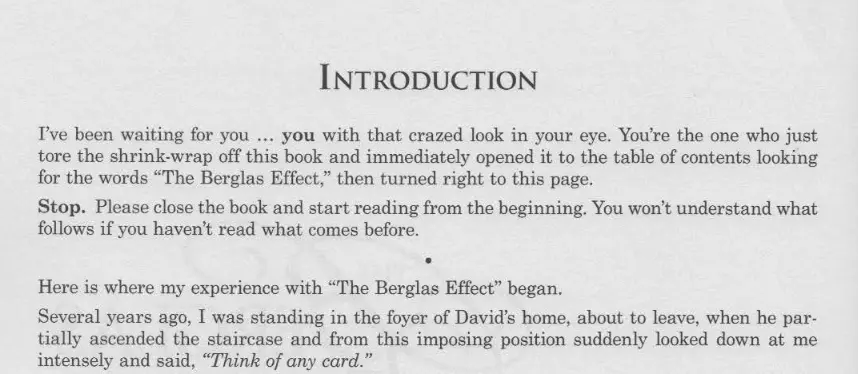
I’ve been waiting for you … you with that crazed look in your eye. You’re the one who just tore the shrink-wrap off this book and immediately opened it to the table of contents looking for the words “The Berglas Effect,” then turned right to this page.
Stop.
Please close the book and start reading from the beginning. You won’t understand what follows if you haven’t read what comes before.
Screenshot from the book
How the Berglas Effect is performed
The biggest secret is that the Berglas Effect is not one single performance but a whole series of performances. Berglas’s real brilliance is that he shows how a “miracle” gets created.
The rules of the Berglas Effect are:
No card force: no using suggestion, sleight of hand, or similar methods to make the spectator land on a specific card.
No relying on psychological ploys, like asking someone to choose a favorite color or number.
During the performance, the magician is not allowed to walk around holding a prepared deck. The deck needs to stay on the table or out of sight.
The magician is not allowed to use their hands to locate the card in the deck, and the count cannot simply be run backward.
The magician is not allowed to use secret maneuvers to control the card into the required position.
In reality, no single performance satisfies all five conditions completely. Sometimes David only meets 1-4. Sometimes he only meets 2-5. But if you perform it often enough, what people remember is the impression that all of them were met.
For example, after the spectator has settled on a card, the magician may only then start thinking about how to present the Berglas Effect. But the performance has to make the audience believe the effect was already in place before the card was ever chosen.
One technique is this: David really does touch the deck in some performances, but spectators are likely to forget that later. In magic, every action produces a result, and one result can cover another, or a larger action can hide a smaller one3.
That is why David keeps stressing this point: in magic, the moment and the experience matter far more than any method. What matters about the Berglas Effect is not being able to reproduce it under every possible condition, but knowing what kinds of conditions allow the Berglas Effect to appear.
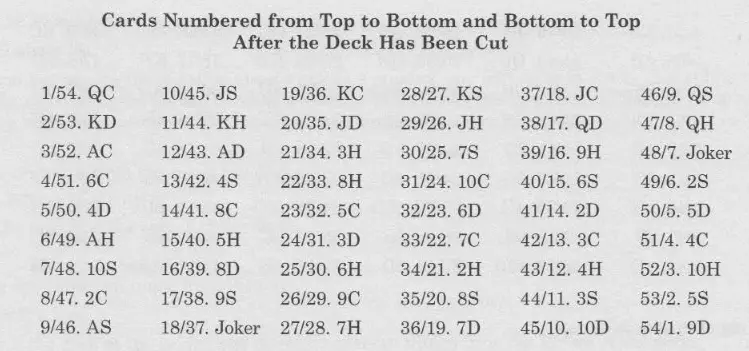
The magician has actually memorized the deck. That means when the spectator names a number, the magician already knows where the target card sits in the stack. What remains is figuring out how to make that card appear there.
This means the magician can quickly track a card’s relative position from the top, the bottom, or the middle
At the number-selection stage, the magician may first give prompts like these: pick a number under 10, around 10, between 10 and 20, or above 20. The moment the magician starts giving examples, the choice is already being influenced. Once the spectator has chosen a number, there are still ways to handle it: directly cut off that many cards, count from the bottom up, or count from the top down. Even the reveal after the spectator cuts the deck can help, because the spectator may expose the position of the bottom card, which gives you a rough sense of the relative positions in the whole deck.
For example, if the magician knows the needed position is 8, they might say, “Give me an example - 5, 6, 7, something like that.” That is really a way of nudging the spectator toward a small number, and it works more strongly than simply saying, “Give me a small number.” Tone, cadence, and pauses can all function as suggestion. The most important part of the performance is making the spectator feel that they are choosing freely.
Doing all of that quietly and naturally is the hardest part of performing magic. At minimum, the magician has to judge before which spectator action they need to finish their thinking. One useful fact is this: the spectators do not actually know what the magician’s next step is.
So when the spectator cuts the deck and you miss the key card, you can simply let them keep cutting until you recognize the locator card. From the magician’s point of view, this is just making the trick easier; from the spectator’s point of view, the extra cutting only makes the trick seem more complicated.
Another technique lies in how the number is interpreted. Suppose the magician knows the correct card is the fifth card, but the spectator casually says 4. The magician can explain it like this: remove the first 4 cards, and the fifth card is the one you are thinking of.
Following the same logic, the magician can also ask the spectator to count from the middle. If the spectator says 3, for instance, the magician can ask them to cut to the middle first, then count 3 from the top or from the bottom.
If there is a Joker in the deck, the count can also be based on the Joker’s relative position. More flexibly, it can be based on some other card, or on excluding a certain category of cards. If the spectator says 13, for example, the magician might say not to count the black cards, only the red ones, and then count in order. That makes the counting itself much more complicated, of course.
In short, the same target card can be reached by many different numbers: counting from the top, from the bottom, from the middle, relative to a Joker, and so on… (David says that for an ordinary card, he usually has more than ten different numbers available.)
The next technique is changing people. If one person names a number that does not help you, you can use that number to switch spectators. For example: you chose 3? Good. Then the next spectator will be the third person to your left, and they can name a new number (or a new card). Asking a spectator whether they want to change their number works on the same principle.
These methods do two things at once: they are low-key, natural forms of control, and they also highlight that the magician never touched the cards.
Other actions work the same way. Naturalness is the hardest part. Magic performance is never about announcing to the audience what you are about to do. That does not feel natural. Every move has to take into account what the audience noticed and what information they think they received.
Liu Qian’s version
Liu Qian currently has four recorded versions on video.
Compared with David’s version of the Berglas Effect, the most startling thing is how mature Liu Qian’s later two performances are4. He always turns the cards over from the top down, which means there is no need to over-explain the number.
In Liu Qian’s version, there are always two people: one names the suit and value, and the other names the number. That alone completes the double randomness. (It almost feels as if true freedom under any conditions has really been achieved!)
During the actual performance phase, Liu Qian really does not touch the cards.
The decks are not identical. I actually compared the order of the suits in two performances, and the relative order is not the same.
It really does look as though Liu Qian may have performed a full version of the Berglas Effect (except for not displaying the deck at the beginning), which is why Berglas once praised Liu Qian’s version as better than his own.
From Liu Qian’s Weibo: Berglas’s signed inscription for Liu Qian, praising his version as better than his own
Since there is no shuffling or cutting at all, it is reasonable to guess that Liu Qian had memorized the deck. If there are no stooges, then the key must lie either in the card-selection stage or in the props.
Rather than a card trick in the narrow sense, this is better understood as a magic effect presented with cards as the prop. ↩︎
This book once came with a DVD that recorded David performing the Berglas Effect at the Bull Theater, which is what made me think of this analogy. For related discussion, take a look at this forum thread. ↩︎
This technique also shows up in Liu Qian’s magic lessons. It is crucial to make the audience believe a miracle happened while overlooking the ordinary little details. ↩︎
In the first two performances, Liu Qian actually does touch the cards; they use gimmicked cards. ↩︎